
In this fast-moving world, money management is more crucial than ever. Whether you are a student, working individual, or entrepreneur, how you manage your personal finances can build your future. One of the best and most popular vehicles in financial planning is mutual funds. In this blog, we will discover all that you should know regarding Personal Finance (Mutual Funds), the way they work, their advantages, disadvantages, and why learning them with proper guidance is essential.

Introduction to Personal Finance (Mutual Funds)
Personal finance is all about managing your earnings, savings, and investments to secure your future. Of the different investment options like stocks, fixed deposits, and property, mutual funds are an easy and flexible choice.
Personal Finance (Mutual Funds) benefit from professional management, diversity, making it a favourite among new as well as seasoned investors.
At IISMT Institute, we train students not just in the basics of mutual funds but also in how to use them practically in private wealth creation and finance planning.
What Are Mutual Funds?
Mutual funds collect money from various investors and invest it in various assets like stocks, bonds, and money market instruments. The pool of money is managed by experienced fund managers to achieve the highest possible returns on investment and control risks.
When we speak of Personal Finance (Mutual Funds), the largest benefit is accessibility. Even with the minimal amount of ₹500 per month via SIP (Systematic Investment Plan), you can invest and own a part in the growth of financial markets.
Mutual Fund Types in Personal Finance
Various objectives require various types of funds Some general types are:
- Equity Funds: Best for long-term wealth creation.
- Debt Funds: Best for stability as well as for short-term objectives.
- Hybrid Funds: A Mix of equity and debt for moderate risk.
- ELSS (Equity Linked Savings Scheme): Excellent for tax-saving under Section 80C.
In Personal Finance (Mutual Funds), choosing the right category depends on your risk appetite, investment horizon, and financial goals. At the IISMT Institute, students learn how to study fund types and pick the right one.
Benefits of Personal Finance (Mutual Funds)
Why should mutual funds be a part of your financial plan?
- Diversity – Your funds are diversified across many securities lowering risk.
- Professional Management – Professionals take investment decisions on your behalf.
- Liquidity – Open-ended funds can be effortlessly redeemed.
- Affordability – Invest small amounts through SIP.
- Tax Benefits – ELSS offers tax deductions under Section 80C.
This is the reason why Personal Finance (Mutual Funds) has been a favourite with Indian investors, particularly young working people.
Risk in Personal Finance (Mutual Funds)
No investment option is risk-free, and mutual funds are not an exception. Some of the risks are:
- Market Risk – Changes in the stock or bond market may impact returns.
- Interest Rate Risk – Debt funds are prone to interest rate changes.
- Credit Risk – The Likelihood of default by indebted companies.
- Inflation Risk – Returns may sometimes fall short of inflation.
At IISMT Institute, we teach students risk management strategies so they can minimise losses and maximise gains in Personal Finance (Mutual Funds).
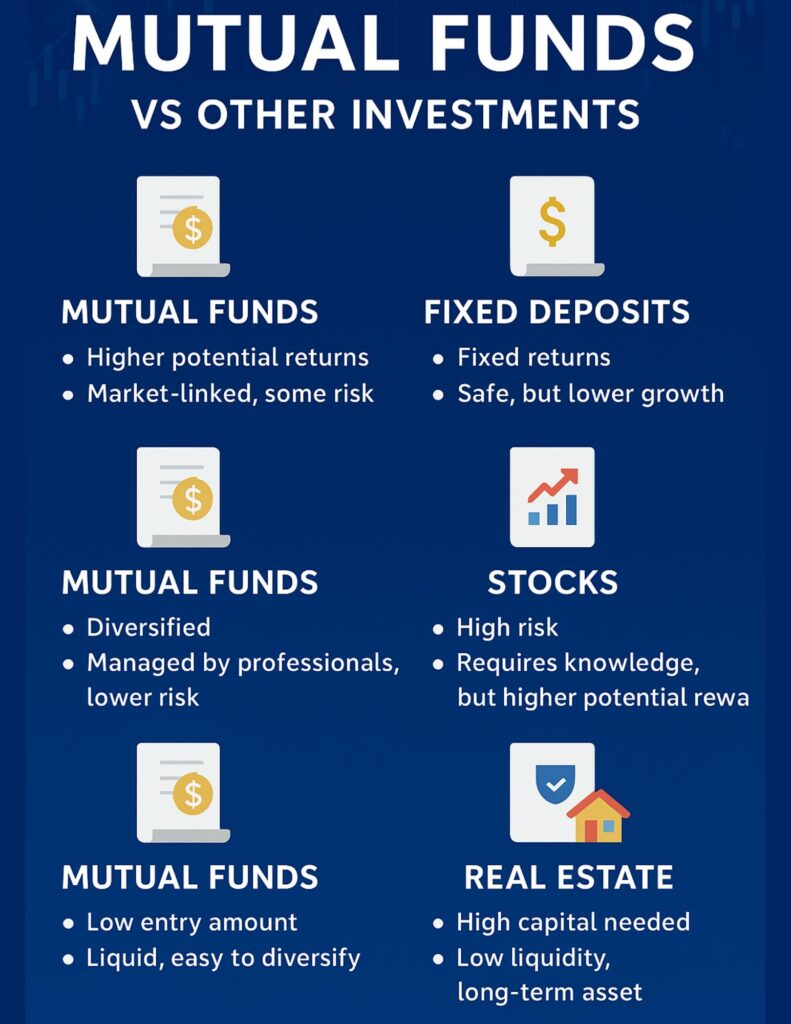
Mutual Funds vs Other Investments
When comparing with other instruments, Personal Finance (Mutual Funds) provide a balance of returns and risk.
- Versus Fixed Deposits – Greater returns but with risk.
- Versus Direct Stocks – Lesser risk due to diversification and expert handling.
- Versus PPF/EPF – More flexibility with better liquidity.
This makes them ideal for anyone building a modern-day financial portfolio.
How to Start Investing in Personal Finance (Mutual Funds)
It is easy to start if you do the following:
- Set Financial Goals – Retirement, education, holiday, or wealth accumulation.
- Measure Risk Appetite – Conservative, moderate, or aggressive.
- Complete KYC – Compulsory for all investors.
- Select SIP or Lump Sum – Income and cash flow dependent.
- Monitor and Review – Periodic monitoring.
Through our stock market and finance courses at IISMT Institute, we take you through each step so that you can invest with confidence and create your portfolio.
Key Metrics in Personal Finance (Mutual Funds)
Check these indicators before investing:
- NAV (Net Asset Value) – Price per unit of a fund.
- Expense Ratio – Charge made by the fund house.
- Exit Load – Charge on pre-withdrawal.
- Past Performance – Performance in the past (although not assured).
- AUM (Assets Under Management) – Fund size and stability.
Our students at the IISMT Institute learn to practically analyse these parameters while studying Personal Finance (Mutual Funds).
Role of Mutual Funds in Financial Planning
Mutual funds are not investments alone; they are financial instruments that aid every life objective:
- Emergency Fund – Liquid funds provide easy availability of cash.
- Retirement Planning – Long-term increase equity funds.
- Child Education/Marriage – Goal-based hybrid funds.
- Wealth Creation – standard SIPs in equity funds for growth.
- Tax Saving – ELSS for tax allotments and long-term capital gains.
In short, Personal Finance (Mutual Funds) fit into every stage of financial planning.
Mistakes to Avoid in Personal Finance (Mutual Funds)
Even the best investors make mistakes. Common ones include:
- Investing without clear goals.
- Exiting too soon due to short-term volatility.
- Spreading money across too many funds.
- Ignoring expense ratios.
- Following herd mentality without research.
At IISMT Institute, we train students to think logically, not emotionally, while managing Personal Finance (Mutual Funds).
Future of Mutual Funds in India
The Indian mutual fund sector is expanding fast. Trends are:
- Rise of SIPs – Crores of new investors become a part of it each year.
- Indifferent Investing – Index funds and ETFs are now popular.
- Digital Platforms – basic investments through apps and advisors.
- Stronger Regulations – SEBI is making things more transparent.
Definitely, Personal Finance (Mutual Funds) will remain the investment drivers in the times to come.
Why Learn Mutual Funds with IISMT Institute?
While online guides and apps can give you surface-level information, real mastery comes from practical learning. IISMT Institute, based near Nirman Vihar Metro in Delhi, is a leading stock market and finance training centre.
We don’t only educate theory we provide live market training, hands-on analysis, and case studies that enable students to excel in Personal Finance (Mutual Funds). From novice to skilled learners, our courses guarantee that you can make the right, profitable choices.
If you wish to safeguard your financial future through mutual funds, studying from the IISMT Institute can be your most suitable choice.

Conclusion
Managing money wisely is not just about saving; it’s about making your money work for you. Mutual funds are perhaps the best financial planning tool in the present times. They provide diversification, expert management, flexibility, and long-term growth prospects.
By learning Personal Finance (Mutual Funds), establishing well-defined goals, and not repeating some common errors, you can ensure your financial success.
And don’t forget knowledge is your largest investment. IISMT Institute offers the ideal platform to learn, practice and be a master of mutual funds. Be your own financial independence today.