
In the current era, finance and society are converging into a single entity. Investors are not just seeking money today but also want their money to be used for the well-being of society. Social Stock Exchanges fill this gap. They provide a unique platform that brings investors, social enterprises and non-profit organisations together so that financial capital is directed at causes that have long-term social influence.

What are Social Stock Exchanges?
Social Stock Exchanges are committed platforms through which investors can invest in systems that are committed to resolving social, environmental, and development problems. Social stock exchanges differ from normal stock exchanges, which are concerned with financial returns alone, in that they are concerned not only with financial viability but also with measurable social returns.
The underlying principle is to narrow the space between investors who want to give back to society and businesses or NGOs that lack funds to meet their goals. By doing so, social causes are provided with structured and transparent financing, while investors have access to the social impact of their donation.
The Evolution of Social Stock Exchanges Globally
The concept of Social Stock Exchanges originated in the early 2000s when governments and financial experts began exploring ways to align capital markets with social good. Countries like the United Kingdom, Brazil, Canada, and South Africa pioneered the concept with dedicated platforms.
For example:
- The UK Social Stock Exchange in London aimed at increasing transparency for socially responsible companies.
- Brazil launched BOVESPA Social, an exchange to link investors with non-profits.
- Canada applied SVX (Social Venture Connexion) to facilitate investments in social ventures.
- South Africa created SASIX (South African Social Investment Exchange) to fund effective organisations directly.
These pilot tests showed that finance could be redesigned as a useful tool of inclusive growth, and they set the stage for countries like India to adopt the idea.
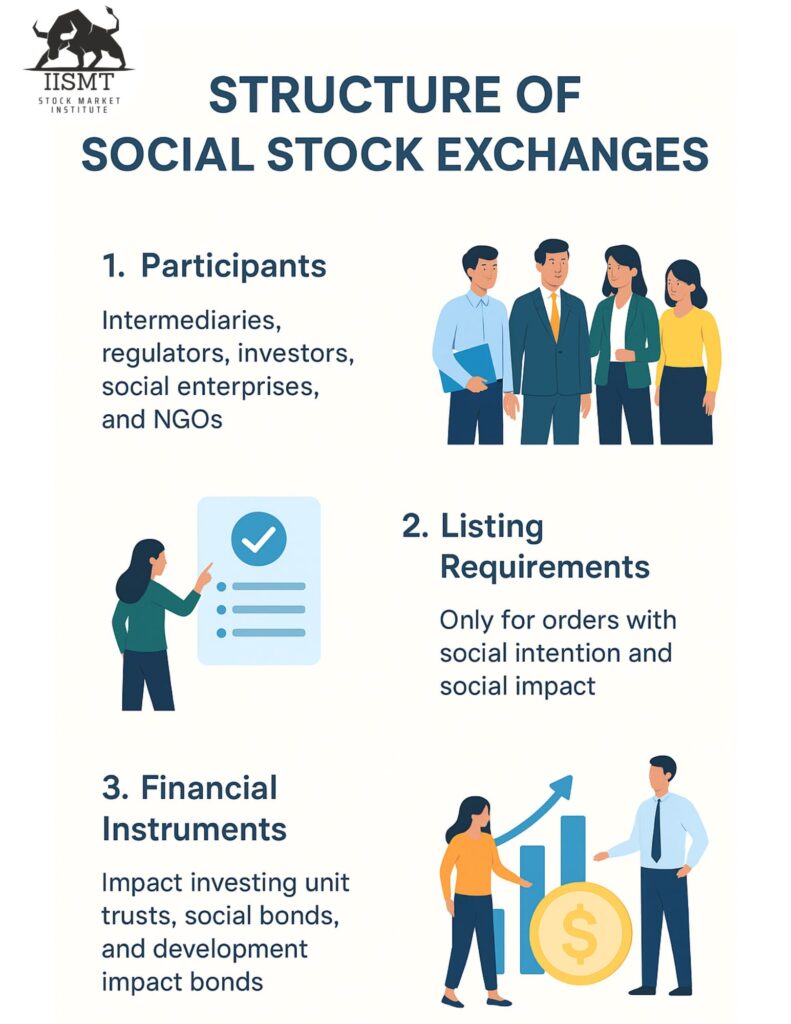
Structure of Social Stock Exchanges
Social Stock Exchanges are structured in a way similar to traditional stock exchanges, but with an additional sharper focus on social responsibility. The main elements are:
Participants: Intermediaries, regulators, investors, social enterprises, and NGOs.
Listing Requirements: Listing is allowed only for orders with social intention and social impact. These are section 8 companies, India registered charities, and social trusts.
Financial : These transactions primarily facilitate vehicles like impact investing unit trusts, social bonds, and development impact bonds, rather than equity shares.
Impact Reporting: orders are required to report outstanding from time to time in terms of the use of funds and the impact created.
This system renders the social responsibility measurable, transparent, and accountable.
Social Stock Exchanges in India
India launched Social Stock Exchanges under the Securities and Exchange Board of India (SEBI). The Indian model is distinct in that it encompasses membership of both for profit social enterprise and non profits, as long as they quantify measurable social impact.
Highlights are:
Acceptability: NGO must be a registered charitable trust, society, or Section 8 company.For-profit companies should evidence clear social intent.
Fund Options: Zero-coupon zero-principal securities, gifts, and social venture capital funds.
Clarity: Mandatory impact reporting and disclosure standards.
SEBI Role: SEBI enforces compliance, investor protection, and accountability in fund practice.
This initiative is particularly important in India as the nation has a large network of NGOs working in areas like education, health, poverty alleviation, and women empowerment, and many of them struggle to raise funds. Social Stock Exchanges provide for access to capital by these organisations, transparent and formalised.

Benefits of Social Stock Exchanges
The emergence of Social Stock Exchanges has several benefits to different stakeholders:
- For Social Enterprises and NGOs
- Accessible and long-term funding
- Greater credibility and visibility
- Capacity to scale impact-based initiatives
For Investors
- Option to participate in impact-based investments
- Transparency of reporting on utilisation of funds
- Alignment of investments with personal values and ESG considerations
For Society
- Enhanced accountability of social enterprises and NGOs
- Quicker advancement towards resolving social and environmental issues
- Creation of an organisational investors’ strong, inclusive development ecosystem
Challenges to Social Stock Exchanges
Despite the advantages, Social Stock Exchanges have some challenges:
- Measuring Impact: Social impacts cannot be as easily measured as financial returns. Systems are still developing
- Awareness: Investors are not familiar with impact investment opportunities. NGOs might also be unaware of listing requirements.
- Liquidity Issues: Unlike traditional exchanges, trading and buying of securities on Social Stock Exchanges is not consistent, hence the liquidity is minimal.
- Regulatory : Reporting for regulations is difficult and expensive for NGOs and small enterprises.
Widespread adoption could be limited unless these issues are resolved.
Future possibilities of Social Stock Exchanges
The future of Social Stock Exchanges is bright, especially with the global push for ESG (Environmental, Social, and Governance) investing. As investors increasing demand for responsible investment opportunities, the scope of SSEs will expand.
Key growth drivers include:
- Technology: Digital platforms can simplify impact tracking and improve transparency.
- Policy Support: Governments are likely to create favourable policies to encourage participation.
- Global Collaboration: Learning from global models can help improve local practices.
- Increasing Awareness: As more young investors aim to align values and money, Social Stock Exchanges will become increasingly popular.
In the long term, these platforms will be able to change the function of capital markets, such that finance is not merely about profit but also purpose.
Role of Education in Promoting Awareness
Although the potential of Social Stock Exchanges is vast, due to a lack of awareness, even this remains underutilized. That is why institutions and schools play their role.
At IISMT Institute, we are not only educating students and professionals on conventional financial markets but also mentoring novel ideas such as Social Stock Exchanges. Through this information on the mentioned transactions, students are able to:
- Discover the intersection of finance and social responsibility.
- Get access to worldwide impact investing trends.
- enlarge your careers in sustainable finance, ESG investing, and development work.
If you wish to understand how finance is able to give your profits a boost and lead to actual change, IISMT offer you live market training and mentoring guidance.
Conclusion
Social Stock Exchanges are not merely financial platforms – they are instruments of social transformation. By linking investors to social enterprises, they ensure that capital goes into areas that have a direct impact on society. Although there are challenges, the future holds promise as global interest in responsible investing continues to grow.
For investors, it is a way to earn money while changing the world. For social enterprises and NGOs, it’s a way to get to sustainable financing. And for society as a whole, Social Stock Exchanges are a bridge from finance to humanity.