
But by only limiting oneself to the Indian market, the growth of the overall portfolio would be limited in today’s financially rapidly changing world. With accelerating innovation of global companies and wider diversification provided in international markets, many more Indian investors are seeking trading in international markets. Be it investing in Apple, understanding the S&P 500, or tapping into fast-growing sectors like AI, electric vehicles, or biotechnology, global trading opens up a world of opportunities.
This blog provides a complete, detailed, and beginner-friendly guide to trading in international markets, specifically designed for Indian investors.

1. What Does Trading in International Markets Mean?
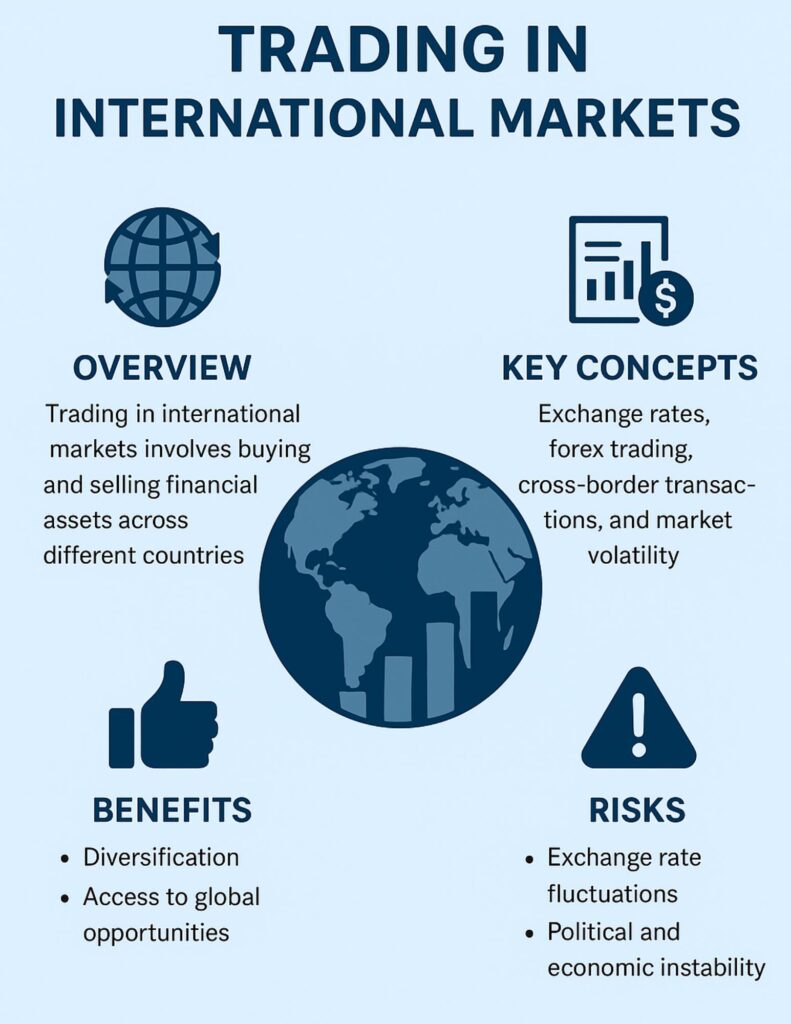
Trading in international markets simply refers to buying or selling financial instruments-stocks, ETFs, index funds, or derivatives-listed outside your home country. Instead of investing in the NSE or BSE alone, you look toward other foreign exchanges such as:
- NASDAQ & NYSE (USA)
- FTSE (UK)
- DAX (Germany)
- Nikkei (Japan)
- Hang Seng (Hong Kong)
International trading enables investors to participate in the world’s biggest companies, strongest economies, and emerging global trends.
2. Why Should Indian Investors Consider International Trading?
There are several strong reasons why trading in international markets has gained immense popularity in India:
a. Global Diversification
Markets don’t move in the same direction at the same time. When Indian markets underperform, global markets may perform well. This balance reduces overall risk.
b. Access to Global Leaders
Many companies which shape the future are not listed in India. For example,
Tesla is the leading electric vehicle maker, henceforth referred to as EV.
- NVIDIA (AI & GPUs)
- Microsoft, Apple, Google (Tech)
- Moderna (Biotech)
Investing abroad gives you the opportunity to participate in worldwide innovation.
c. Higher Liquidity
Major international exchanges have significant trading volumes, which leads to the following:
- More stable pricing
- Faster execution of orders
- Lower slippage
d. Exposure to Different Sectors
Sectors that are not well represented in India include global defence, aerospace and specialised biotech. International markets fill this gap.
3. International Markets Most Favored by Indians
The most popular destinations for trading in international markets are:
✔ USA – NASDAQ and NYSE
The most preferred destination due to:
- Tech dominance
- Strong regulations
- Massive liquidity
✔ Europe
- Includes FTSE (UK), DAX (Germany), and CAC (France).
- Known for energy, pharmaceutical and automobile giants.
✔ Asia-Pacific
- Japan, Hong Kong, and South Korea provide substantial exposure to electronics, robotics and method.
✔ Emerging Markets
- Brazil, South Africa and Taiwan offer high-growth opportunities with higher risks.
4. What Can Indians Trade in International Markets?
When trading in international markets, Indians can access a wide range of instruments:
1. Stocks of the World
Buying shares directly in companies such as Apple, Intel, or Coca-Cola.
2. International ETFs
- Exchange-Traded Funds replicating:
- Countries: US, Japan, UK
- Global sectors: AI, EV, Tech
- Indexes: S&P 500, NASDAQ 100
3. ADRs/GDRs
American or Global Depository Receipt: A foreign stock trading in the US makes it easier to invest in.
4. Index Funds
Low-cost global portfolios for long-term compounding.
5. Currencies and Commodities
For advanced traders, forex and world commodities open additional opportunities: gold and crude oil
5. How can Indians start trading in International Markets?
There are main options for trading in international markets:
Indian Brokers Offering Global Access
Several brokers regulated by SEBI have teamed up with international platforms for facilitating investment services worldwide.
✔ Direct International Brokers
- These provide deep access to global markets but need added verification.
- Global Investing Apps
- Fractional investments in US stocks are possible through beginner-friendly applications.
✔ International Mutual Funds & ETFs
Best for passive investors who do not want to open a global trading account.
6. Regulatory Requirements for Indian Investors
Before trading in international markets, it’s important to understand regulatory requirements:
- LRS stands for Liberalised Remittance Scheme.
- Indians are allowed to invest upwards of USD 250,000 per financial year for international investing.
- FATCA Declaration
- Required for US market participation.
- Taxation Rules
- The withholding taxes on dividends and capital gains are different in various countries.
- KYC & Verification
- PAN, Aadhaar, address proof, and bank details will be required.
- Understanding regulations for safe and compliant investing.
7. Risks Involved in International Trading
Just like domestic trading, trading in international markets carries risks:
✔ Currency Fluctuation
- Your profits can increase or decrease depending on the USD-INR movement.
- Time differences between zones
- US markets function at night in India This requires late control.
✔ Higher Charges
- Foreign brokerage fees, conversion charges and international transfer costs are slightly higher than domestic trading.
✔ Geopolitical Risks
- Events like war, elections, and changes in policy have a high level of impact on world markets.
- Market Regulations
- Every country has its own set of trading rules, settlement cycles and taxes.
- Knowledge of these risks helps investors to make informed decisions.
8. Successful International Trading Strategies
1. Invest in ETFs
- You could consider starting with large market ETFs rather than individual stocks
- S&P 500
- NASDAQ 100
- Global technology ETFs
2. Diversify Across Countries
- Do not invest in the US alone. Add exposures to both Europe and Asia for better stability.
3. Invest in Global Themes
Consider long-term themes like:
- AI
- Clean energy
- Space exploration
- Cybersecurity
- Biotechnology
4. Avoid charge Any One Stock
- Even the strongest companies have drawdown periods.
5. Keep an eye on global economic indicators.
Keep an eye on:
- US Fed interest rates
- Inflation data
- GDP numbers
- Global earnings season
- These factors have a direct impact on the movement of the market.

9. Taxation for Indians Trading Abroad
- Dividend Tax
Most countries withhold withholding tax; in the US, it is 25% for Indian residents.
- Capital Gains Tax
Short-term and long-term gains are, respectively, applicable depending on the holding period.
Gains are required to be reported in your Indian ITR under foreign assets.
DTAA – Double Taxation Avoidance Agreement
The deduction prevents a situation of double taxation on income acquired from the same source.
Understanding the Market and taxation ensures even compliance, thereby avoiding penalties.
Conclusion
Trading in the international markets allows Indian investors to create a truly global portfolio. With access to world-leading companies and diversified sectors in more stable economic environments, global investing has become an integral part of modern wealth creation. While there are risks of currency fluctuations, time zones, and taxation, proper research, smart strategies, and disciplined investment can help you maximise returns and reduce risks.
Whether you are a beginner exploring international ETFs or an experienced trader diversifying across continents, the world is now open for investment.