If you are interested in entering the universe of derivatives and trading like a pro, then taking a futures trading Course is one of the best things that you can do. Futures are some of the most active and liquid financial instruments that can be found in the market. From hedging risk to speculating on price fluctuations, futures offer traders and investors immense power. But with no training and knowledge, futures trading can also prove to be extremely risky. That’s where a systematic Future Trading Course is needed.
In this blog, we will tell you what futures trading is, why it is necessary to learn, the advantages of enrolling in a futures trading Course, and how IISMT (Indian Institute of Stock Market Training) makes it easy for you to master this skill with live market exposure.
What is Futures Trading?
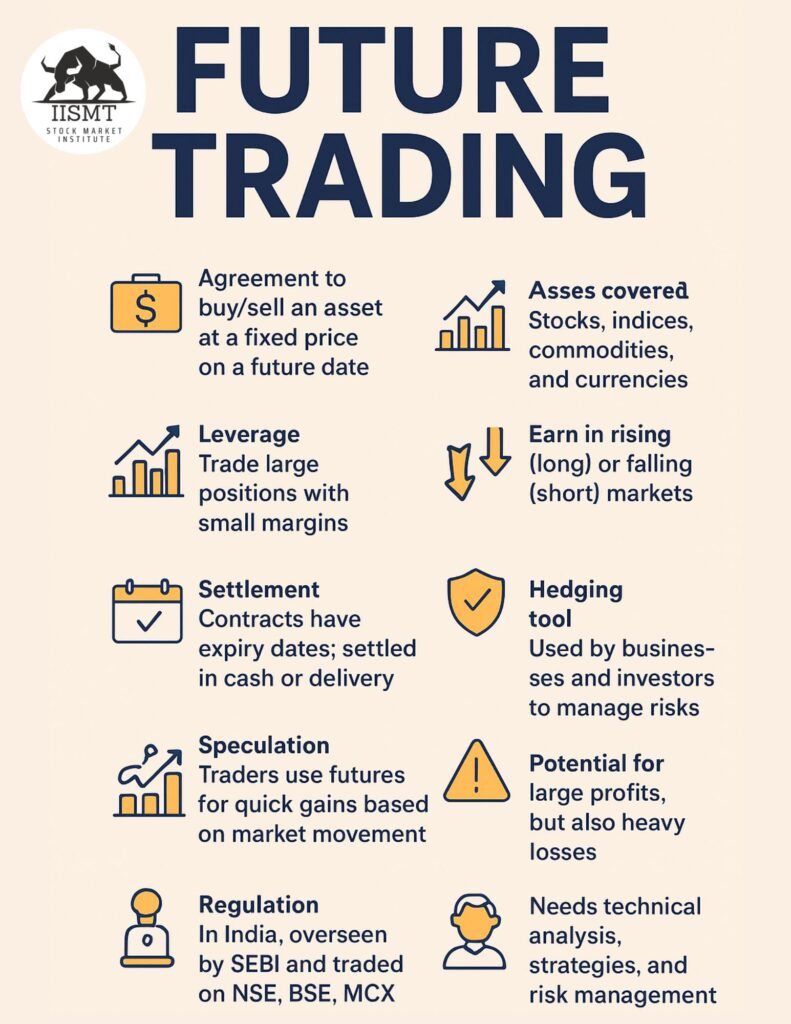
Futures trading is a derivatives trading in which two parties agree to buy or sell an asset at a predetermined price on some future date. Assets that may be traded are stocks, indices, commodities, and currencies. Futures are different from stock investing in that both increasing and decreasing markets can be profited from using the long or short position.
Example: If you think that Nifty will go up, you can purchase Nifty futures. If you think that Nifty will go down, you can sell Nifty futures.
But here is the catch futures come with margin, leverage, and high volatility. Without proper risk management, begginers end up losing money. That’s why a well-structured Future Trading Course is important to build the right foundation.
Why Take a Future Trading Course?
You may ask, “Can I simply learn futures trading on social media or YouTube?” The fact is, futures trading is not something you can learn from random advice or poorly cooked videos. A Professional Future Trading Course provides you with:
- Structured Learning – Step by step, from the basics to high-level concepts.
- Live Market Practice – You don’t learn theory you trade in actual market conditions.
- Risk Management – Learn to guard your capital with correct stop-loss and money management.
- Strategy Development – Practice-tested intraday, swing, and hedging strategies.
- Expert Mentorship – Learn directly from experienced traders who know market psychology.
Who Should Take a Future Trading Course?
A Future Trading Course is suitable for:
- New entrants to derivatives trading wishing to learn proper knowledge.
- Share market traders looking to move from the cash market to leveraged trading.
- Business entrepreneurs who want to hedge against risks commodity.
- Investors who want to shift their portfolio through futures.
- Career seekers seeking employment in prop trading houses, hedge funds, or banks.
Important Modules That Would Be Taught in a Future Trading Course
While enrolling in a professional Future Trading Course, the following can be expected to be taught:
1. Overview of the Futures Market
- Derivatives and futures contract basics
- Why futures are different from options and stocks
- What exchanges and SEBI have to do with India
2. Futures Contracts Defined
- Lot size, expiry, tick size, and settlement
- Margins and mark to market (MTM)
- Index, stock, commodity, and currency futures
3. Technical & Fundamental Analysis
- Reading charts for futures trading
- Key indicators (RSI, MACD, Moving Averages)
- Impact of economic data on futures prices
4. Futures Trading Strategies
- Intraday strategies (scalping, breakout, trend-following)
- Swing & positional strategies
- Hedging and arbitrage with futures
- Spread trading techniques
5. Futures Risk Management
- Stop-loss and target setting role
- Position sizing and capital handling
- Avoidance of over-leverage errors
6. Sophisticated Futures Concepts
- Open interest and volume analysis
- Contango and backwardation
- Pair trading and beta hedging
7. Live Market Training with a Hands-On Approach
- Placing actual orders on a trading platform
- Selecting the proper contract to trade
- Practical hands-on training on Nifty, Bank Nifty, and stock futures
After this course, you will not only know futures, but you will be confident to trade on your own.
Benefits of Studying Using a Future Trading Course
- Trade Like a Pro – You no longer risk, but make informed decisions.
- Profit in Both Directions – With futures, you can profit in both up and down markets.
- High Leverage Possibilities – With small margins, you can take large positions.
- Risk Management Techniques – Protect Yourself from Large Losses.
- Job Opportunities – Open Doors to Employment in Trading and Financial Professions.
Why IISMT is the Best Option for Future Trading Course
We don’t teach theory at IISMT (Indian Institute of Stock Market Training), we teach application. Our Future Trading Course is specifically tailored for both new and experienced learners who want to learn futures trading.
Here is why IISMT stands out as the best choice:
- Live Market Training – Students prepare with live market sessions.
- Mentorship – professional traders with years of experience in the live market.
- Strategies – We teach you trading strategies that work in markets.
- Doubt-Clarification Sessions – One-on-one mentorship to get concepts totally clear.
- Placement Assistance – For students keen on career-making in trading.
Career Prospects Following Future Trading Course
With a Future Trading Course, you can look at:
- Professional Futures Trader – Trade on your own with discipline.
- Prop Trading Companies – Work for companies that finance your trades.
- Investment Advisory – Guide others in futures trading (with SEBI license).
- Portfolio Hedging – Hedge risks for businesses and investors.
- Stock Market Trainer – Train and guide new students.
Common Mistakes to Avoid in Futures Trading
Despite taking a Future Trading Course, most new entrants make errors like:
- Over-leveraging trades
- Trading without a stop-loss
- Relying on random advice on social media
- Forgetting money management
- Being emotional with profits and losses
A good institution like IISMT makes you steer clear of these mistakes by instructing trading psychology and discipline.
Why Learning Futures is Important in Today’s Market
The stock market has become highly dynamic. With increasing volatility, futures trading has become a preferred choice for both traders and investors. Whether it’s Nifty futures, Bank Nifty futures, crude oil futures, or currency futures, there are always opportunities.
But opportunities come with risks. It is only a systematic Future Trading Course that can equip you to manage these risks and convert them into regular profits.

Conclution
A Future Trading Course is the ideal investment in yourself if you are serious about creating wealth through trading or are contemplating trading as a profession. Futures trading can boost your returns, but you have to know the techniques, strategies, and risk management.
At IISMT, we ensure our students learn not only but also practice, apply, and thrive. Through live market exposure, expert mentorship, and learning, you will step out as a confident futures trader.
Don’t let the market teach you costly lessons. Learn professionally, trade confidently, and create your financial future.