
In the fast-paced financial times we live in, making decisions to be correct, forward-thinking, and systematic is crucial to grasp the performance of a business. This is where Integrated Financial Modelling is the keystone of corporate finance, investment analysis, and strategic planning. You may be an emerging analyst, entrepreneur, or finance practitioner, but being a master of this skill can be your competitive advantage in navigating intricate financial decisions.
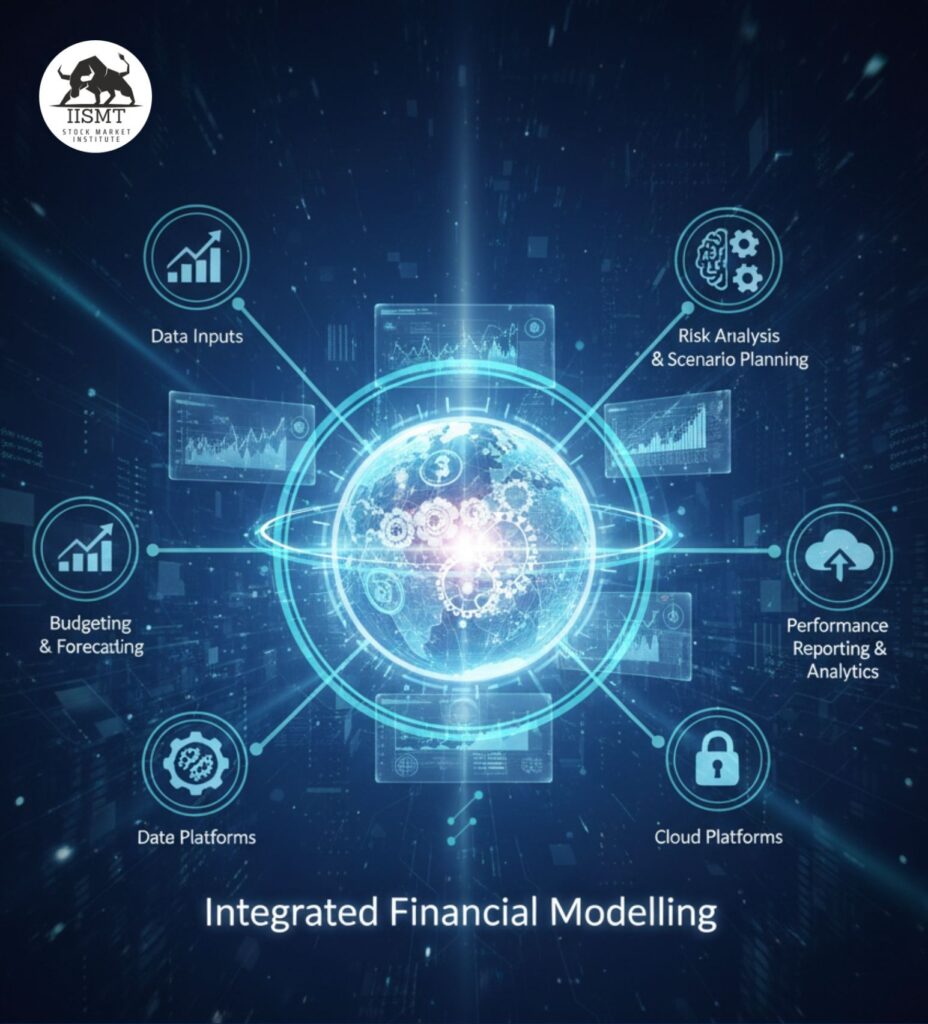
What is Integrated Financial Modelling?
Integrated Financial Modelling is creating a well-organized, linked financial structure that integrates the three fundamental financial statements:
- Income Statement
- Balance Sheet
- Cash Flow Statement
Rather than studying such statements in segregation, the model combines them so that any alteration of assumptions is applied to all statements. For instance, an alteration in sales growth assumptions affects revenue, which affects profits, tax, retained earnings, and eventually the cash flow.
This combination ensures reliability, transparency, and consistency of financial decision-making.
Why is Integrated Financial Modelling Important?
- Correct Forecasting – By connecting assumptions to financial results, companies can predict future performance with certainty.
- Investment Choices – Investors and analysts utilize models to assess company valuations, mergers and acquisitions, or capital requirements.
- Strategic Planning – Firms depend on Integrated Financial Modelling for budgeting, capital allocation, and risk mitigation.
- Transparency – A well-built model ensures that financial results are logically tied to business drivers.
Simply put, without an integrated model, financial decisions often remain fragmented and less reliable.
Core Components of Integrated Financial Modelling
A professional model has three main building blocks, each tightly connected to the others.
1. Income Statement (Profit & Loss Account)
- Revenue assumptions (growth rates, pricing, volume)
- Operating costs and gross margins
- EBITDA and net income
2. Balance Sheet
- Assets: current assets, fixed assets, investments
- Liabilities: borrowings, payables, provisions
- Equity: share capital, retained earnings
3. Cash Flow Statement
- Cash flow from operations
- Cash flow from investing activities
- Cash flow from financing activities
When these three statements are linked, we achieve the essence of Integrated Financial Modelling.
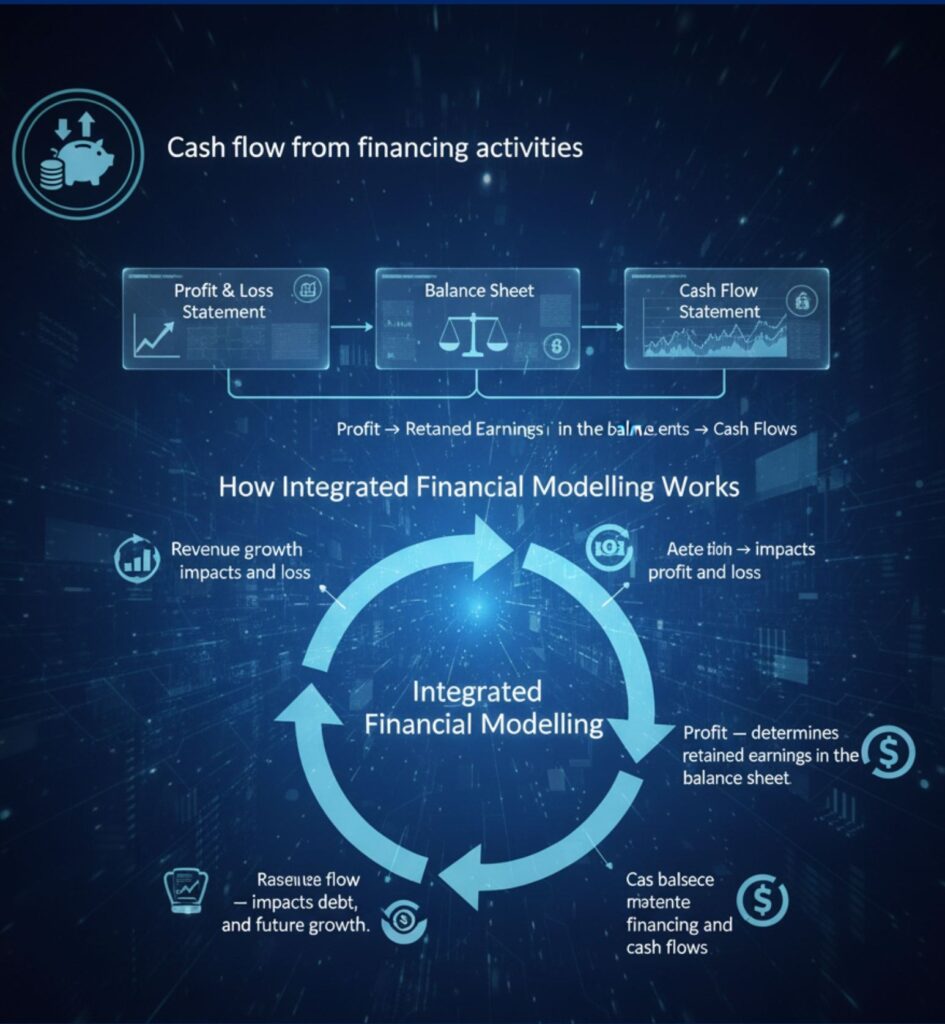
How Integrated Financial Modelling Works
The model is designed to flow logically:
- Revenue growth → impacts profit and loss.
- Profit → determines retained earnings in the balance sheet.
- Balance sheet movements → influence cash flows.
- Cash flow → impacts debt, financing, and future growth.
For example, if a company plans to borrow more money, interest costs will increase in the income statement, debt levels will rise in the balance sheet, and financing cash flows will reflect loan inflows.
Assumptions and Drivers in Integrated Financial Modelling
Any financial model’s validity relies on sensible assumptions. Typical drivers are:
- Sales Growth Rate – From market analysis and historic performance.
- Cost Structure – Fixed versus variable costs.
- Capital Expenditure (CapEx) – Future investment in fixed assets.
- Working Capital opinions – Inventory, accounts receivable, and accounts payable.
- Financing Mix – Debt versus equity financing.
These assumptions are the foundation for scenario planning and sensitivity analysis.
Scenario and Sensitivity Analysis
Integrated Financial Modelling is one of the strengths of being able to test several different scenarios:
- Base Case – Assumptions based on realistic expectations.
- Best Case – High sales and low costs, optimistic scenario.
- Worst Case – Conservative estimate with diminished growth or escalated costs.
Sensitivity analysis enables you to trial what if stories like:
- What if the interest rate rises by 2%?
- What if raw material costs rise by 10%?
- What if sales volume drops by 15%?
This helps firms from risk and make choices.
Applications of Integrated Financial Modelling
1. Valuation of Companies
- Discounted Cash Flow (DCF)
- Comparable company analysis
- Precedent transactions
2. Capital Budgeting
- Appraising new projects
- Determining Net Present Value (NPV) and Internal Rate of Return (IRR)
3. Mergers and Acquisitions (M&A)
- Estimating the financial effects of mergers
- Synergy analysis
4. Project Finance
- Infrastructure and long-term projects need elaborate models for financing.
5. Corporate Planning
- Budgeting, resource planning, and strategy development.
- Best Practices in Integrated Financial Modelling
- Clear Structure – Structure inputs, calculations, and outputs in a rational manner.
- Transparency – Make ideas open and easily changeable.
- Error Checks – Include balancing controls and error-tracking formulae.
- Documentation – Clearly explain ideas and methods.
- User-Friendly Design – Use formatting and navigation for easy interpretation.
At IISMT, our training does not just teach students the theory but also exercises in developing models that adhere to industry best practices.

Tools Used in Integrated Financial Modelling
While Excel remains the global standard, modern finance also employs:
- Excel VBA and Macros for automation
- Power BI and Tableau for visualisation
- Python and R for advanced analytics
- Cloud-based tools for collaborative modelling
They are more privileged than others because they have been trained on both Excel and modern tools.
Case Study Example: Startup Valuation
Consider a tech startup with hyper-growth in revenues being forecasted. Using Integrated Financial Modelling:
- 30% revenue growth is forecasted each year.
- Spend is modelled on expanding operations.
- The balance sheet includes investor funding and asset expansion.
- Cash flow forecasts indicate when the business will need more funding.
This model assists investors in assessing if the startup is investment-worthy and on what terms.
Challenges in Integrated Financial Modelling
Even experienced professionals can face issues:
- Over-complication – Too many details make the model difficult to use.
- Incorrect Linkages – A single broken formula can lead to misleading results.
- Unrealistic ideas – Overly optimistic growth or optimistic costs warp divines.
- Circular References – Ineffective linking results in calculation faults.
Such is the reason structured training is important for the construction of sound models.
The Future of Integrated Financial Modelling
The coming decade will witness a radical change with AI and machine learning doing the job of financial forecasting to some extent. Nevertheless, the fundamental concepts of Integrated Financial Modelling, connecting financial statements, maintaining consistency, and making logical assumptions, will be enduring.
Professionals who combine financial expertise with technology will lead the future of finance.
Learning Integrated Financial Modelling at IISMT
As you look towards a career in finance, equity research, investment banking, or corporate strategy, you will need to be proficient in Integrated Financial Modelling. At IISMT Institute (Laxmi Nagar, Delhi), we offer:
- Simple Training – Construct actual models from scratch.
- Live Market Practice – Gain an understanding of the practice of models in real market scenarios.
- Placement Support – Placement with stockbroking houses, investment banks, and corporates.
- Expert Faculty – Study from business professionals who have years of experience.
Our courses make sure that you not only master Excel formulas but also have a good grasp of business dynamics through financial models.
Conclusion
Integrated Financial Modelling, thus, is not a technical skill in itself; it is a strategic tool that empowers businesses, investors, and professionals with the ability to make conscious decisions. From risk management to valuation, the uses are limitless.
At IISMT, we are convinced that every finance professional and student needs to be proficient in mastering this skill to succeed in the cutthroat business of stock markets and corporate finance. If you aspire to pursue investment banking, equity research, or corporate strategic roles, a solid background in Integrated Financial Modelling will give you an edge.