In the financial markets world, profiting isn’t simply a matter of strategies, technical analysis, or expert advice. The reality is, two pillars are what dictate a trader’s long-term success: risk management and trading psychology. That is why taking a Risk Management and Trading Psychology course is crucial for anyone who wants to succeed and prosper in the stock market.
Whether you are a beginner learning the basics of intraday trading or an advanced trader dealing with derivatives, you will realise one thing: controlling your losses and controlling your mind are far more important than chasing profits. In this post, we are going to look at why this course is important, what it includes, and how it can utterly change your trading experience.
Why Risk Management and Trading Psychology Are Important
Most traders approach the market with hopes of making fast money. They will spend countless hours studying chart patterns, indicators, and techniques. But the best technical configuration is worthless if the trader is undisciplined or takes too much.
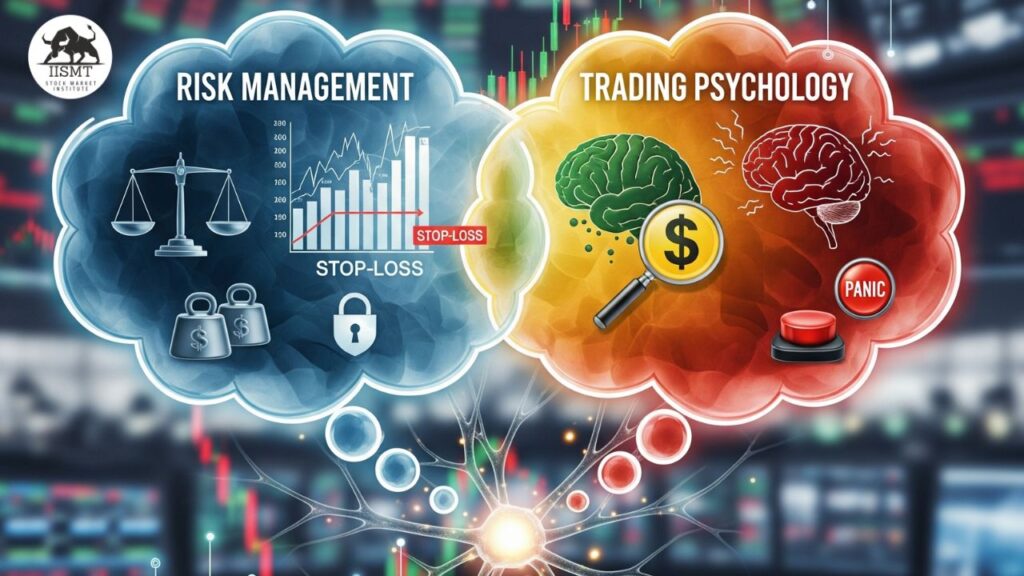
- Risk Management prevents you from blowing your account in one ill-fated trade.
- Trading Psychology helps maintain a serene and focused mind, even if the market forces you to test your patience.
- These two skills guide you on what a Risk Management and Trading Psychology course is.
What is Covered in a Risk Management and Trading Psychology Course?
A Risk Management and Trading Psychology course is not all about theory.It emphasises actual techniques, actual examples, and live trading experience. The modules are:
1. Risk Management Fundamentals
- Risk vs uncertainty definition
- Concepts of risk-reward ratio
- Setting profit target and stop-loss
- Position size and controlling capital
2. Risk Control Tools
- Stop-loss orders
- Hedging by derivatives
- Leverage and margin control
- Volatility indicators utilised such as VIX and ATR
3. Learning Trading Psychology
- Impact of emotions on trade choices
- Overcoming fear and greed
- Detection of biases such as overconfidence and confirmation bias
- Discipline and patience are key to learning
4. Developing a Trader’s Attitude
- Keeping a trades journal for personal reflection
- Stress management strategies like meditation
- Developing positive habits consistently
- Remaining confident but not overtrading
Through the intermixing of these modules, a Risk Management and Trading Psychology course provides the perfect balance between keeping capital and shaping the professional trader’s mindset.
Why Every Trader Must Take This Course
Risk management and psychology are ignored by most of the traders until they experience significant losses. But then, it’s usually too late. Here’s why you shouldn’t wait:
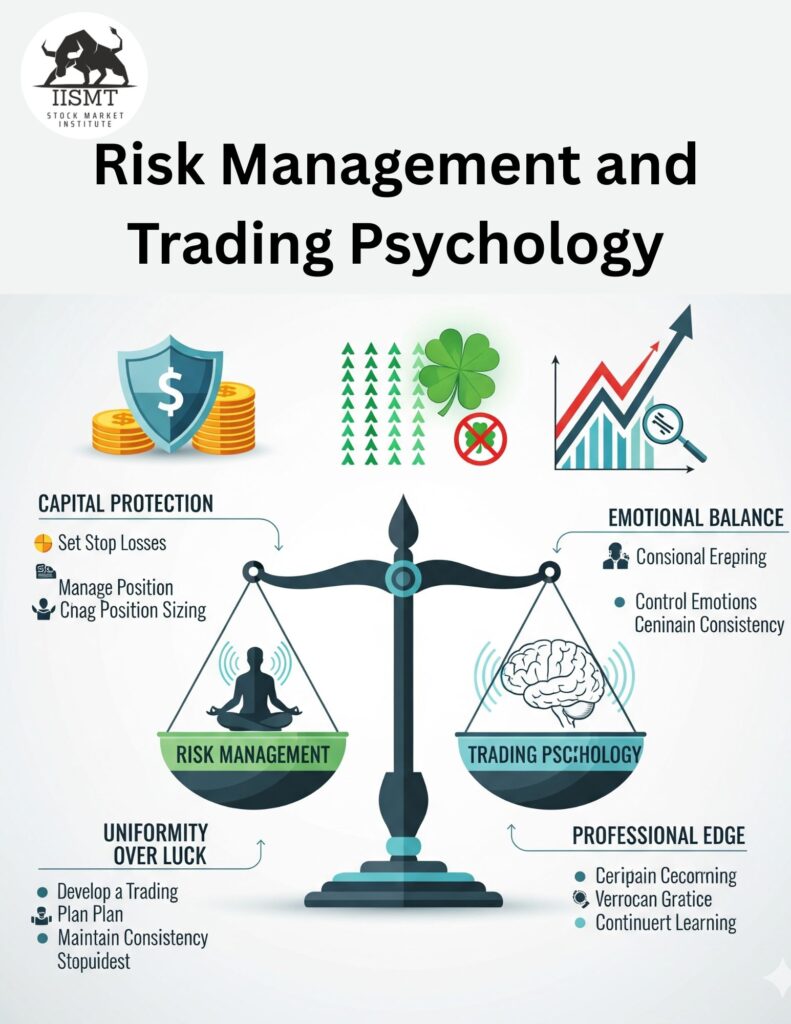
- Capital Protection – Even successful traders sometimes lose. Proper risk management means one loss will never eradicate your trading account.
- Emotional Balance – Markets are unstable. Sound trading psychology prevents panic selling or revenge trading.
- Uniformity Over Luck – Without discipline trading becomes gambling. This course helps you build consistent returns.
- Professional Edge – Institutions and professional traders focus more on risk and psychology than small retail traders. Learning this gives you a big advantage.
By enrolling in a Risk Management and Trading Psychology course, you prepare yourself to think like a professional rather than a casual speculator.
Real-Life Examples of Risk and Psychology in Trading
A trader with no stop-loss once lost his entire capital in a single day when the stock hit lower circuits. A course in Risk Management and Trading Psychology would have informed him about rigid stop-loss discipline.
Another speculator, following several successful trades, became arrogant and over-leveraged his accounts. When the market moved against him, he lost not just profits but also his initial capital. That is where the psychology module comes into play.
On the other hand, traders who learned to maintain a constant risk-reward ratio and controlled their emotions were able to build their accounts gradually but surely.
These real cases highlight why both elements of the Risk Management and Trading Psychology course are inseparable.
How the Course Transforms a Trader
When you join a Risk Management and Trading Psychology course, you start noticing changes in your trading behaviour:
- You no longer panic when trades go against you, because you know your risk is predefined.
- You stop overtrading just to recover losses.
- You learn to accept the small losses as part of the game.
- You focus more on process rather than chasing profits.
- You build the discipline to survive in the market for years, not just days.
- This transformation is what separates losing traders from consistent winners.
Advantages of Enrolling at an Institute
Self-study is possible, but guided instruction makes a huge difference. An institute-conducted Risk Management and Trading Psychology course provides:
- Expert Mentorship – Learning from experienced traders who have encountered actual market adversity.
- Live Market Practice – practicing concepts during live trading sessions.
- Peer Learning – Learning with peers and understanding alternative viewpoints.
- Accountability – Regular assignments and tests keep you in check.
- Certification – A professional certificate gives your trading experience credibility.
These advantages guarantee that you not only learn but also apply the principles effectively.
Who Should Join This Course?
The Risk Management and Trading Psychology course is not meant for beginners alone. It is intended for:
- New Traders – Who do not want to blow up their accounts early.
- Intermediate Traders – Who earn profits but have issues with consistency.
- Advanced Traders – Who wish to develop their psychology and capital protection measures.
- Investors who want to control emotional decision-making during market volatility.
In short, anyone who wants to build a strong foundation for long-term trading success should take this course.
Long-Term Value of This Course
In contrast to methods that can become obsolete as market conditions evolve, the concepts learned in a Risk Management and Trading Psychology course never become obsolete. Human psychology does not change, and risk management concepts are timeless.
This qualifies the course as a lifetime investment. The sooner you learn, the more profitable and safe years of trading you will have.
Why IISMT is the Best Destination for This Course
At IISMT (Indian Institute of Stock Market Training), we are convinced that profitable trading depends as much on risk management and discipline as on smart strategies. Our Risk Management and Trading Psychology course is designed to give you:
- Live market sessions with hands-on experience
- Personal mentoring by experienced traders
- Step-by-step training from basics to advanced concepts
- Real stock market examples and case studies
- Placement guidance for students seeking employment in trading firms
Located in Laxmi Nagar, Delhi, IISMT has helped hundreds of students translate their trading experiences. If you are serious about trading, this is the right place to start.

Conclusion
The stock market is not just about buying and selling shares. It is a battlefield where discipline, patience, and emotional control decide the winner. Strategies can provide short-term profits, but it is only through robust risk management and trading psychology that one can guarantee long-term success.
That is why enrolling in a Risk Management and Trading Psychology course is the smartest decision for any prospective trader. It shows you how to protect your capital, how to gain control of your emotions, and how to become consistent.