
The stock market is an ocean of possibilities where the prices, trends, and sentiments keep on changing. Among all, one of the major powerful forces that shape these movements is derivatives trading. How Derivatives Influence Stock Market basically helps traders and investors alike understand how to go about the complexities of modern financial markets with more confidence and clarity.

Introduction
Before explaining how derivatives influence the stock market, let’s clear up what a derivative actually is. Derivatives are financial instruments that derive their value from some underlying asset such as a stock, index, commodity or currency, and hence provide a means for speculating, hedging, and managing risks without taking ownership of the underlying asset.
Derivatives have gained phenomenal popularity over the years. Nowadays, they are closely tied to the effective operation and stability of the world’s financial system. To fully understand How Derivatives Influence Stock Market, it is necessary to consider both the benefits and pitfalls of their use.
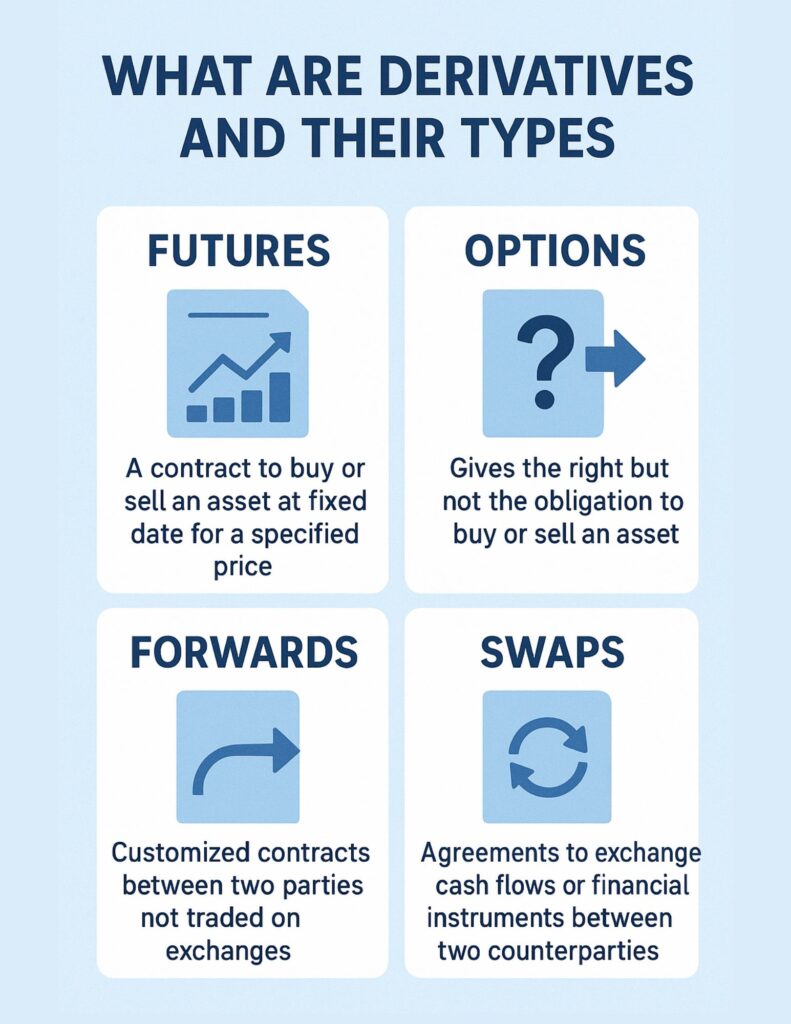
What are Derivatives and their Types
The first step in understanding How Derivatives Influence Stock Market There are four major types of derivatives:
- Futures: A contract to buy or sell an asset at a fixed date for a specified price.
- Options: Give the right but not the charge to buy or sell an asset.
- Forwards: Customised contracts between two parties not traded on exchanges.
- Swaps: agreements to exchange cash flows or financial instruments between two counterparties.
Because each of these Leverage and margins in derivatives interacts differently with the stock market, it affects prices, volatility, and overall sentiment.
The Role of Derivatives in the Stock Market
To understand the way in How Derivatives Influence Stock Market, it’s important to consider their core functions
- Hedging: Derivatives protect the investor. Hedging with derivatives, like futures, is done in a situation where the investor owns shares and feels the market is about to go low.
- Prediction: Traders use derivatives to benefit from anticipated fluctuations in prices. With derivatives the invested money controls great stock positions, making the potential returns and risks higher at the same time.
- Program trading: Professionals exploit price gaps between the cash and futures markets which keeps both markets in step with and efficient with each other.
They give traders more exposure with limited capital, increasing profits or losses.
All these factors combined explain how derivatives influence the stock markets, influencing their liquidity, pricing and investor sentiment.
Positive impacts of derivatives on the stock market
Grasping How Derivatives Influence Stock Market also entails realising their positives. There are various beneficial impacts of derivatives that contribute to the general financial system:
a. Better liquidity
Derivatives enhance trading activity, drawing in institutional investors and retail traders alike. High liquidity ensures that buying or selling of assets becomes easier, reducing volatility in the cash market.
b. Efficient Price Discovery
Market expectations can be assessed through futures and options by investors. For example, Nifty futures reflect the probable movement of the broader market. This information flow is continuous, which sets fair values of stocks.
c. Risk Management
Hedging using various financial derivatives limits the investor’s exposure to unforeseen adverse price movements; this balances out the markets and encourages long-term participation.
d. Efficiency in the Market
Arbitrage opportunities help in keeping stock prices in line with their true market values through derivatives. This balancing act is what enhances overall market efficiency.
These advantages reveal the positive side of How Derivatives Influence Stock Market making it more balanced and transparent for the investor.
Negative Impacts of Derivatives on the Stock Market
However, in getting a full understanding of How Derivatives Influence Stock Market, it’s important to take into account the associated risks and disadvantages.
a. Excessive Speculation
Speculation, though adding liquidity, also introduces volatility. Excessive short-term trading through derivatives can artificially push prices and thereby create panic or euphoria in the stock markets.
b. Leverage Risks
Leverage cuts both ways A small wrong move in the derivative position can lead to massive losses. This can unsettle both individual portfolios and the market as a whole.
c. Systemic Risk
In extreme cases, mismanagement of derivative exposure can result in a financial crisis partly due to the misuse of complex derivatives, the 2008 global meltdown served to show how derivatives affect the stock market negatively if they are not handled carefully.
d. Complexity
Most retailers do not understand derivatives. The lack of understanding could bring about impulsive decisions and unexpected losses.
Consequently, while derivatives bring growth and effiency, they also need strong regulation and responsible trading practices.

Relationship Between Derivatives and Cash Market
To be able to understand fully how Derivatives Influence Stock Market, one needs to grasp how the derivative market and the cash/spot market are interwoven.
Sentiment is affected by futures and options: for example buying more call options reflects bullish expectations, inflating the prices of stocks.
- Rollover Data: High rollover shows confidence in ongoing trends.
- Open Interest Analysis: High open interest usually demonstrates strong market direction and, therefore, dictates the spot prices.
Thus, the markets of derivatives and cash are very interrelated. What happens in one influences the other directly.
Regulatory Oversight and Investor Protection
One important attribute of How Derivatives Influence Stock Market is the regulatory framework. For instance in India all the trading in derivatives is overseen by the SEBI Securities and Exchange Board of India to ensure that the markets are transparent without any manipulation.
Key activities:
- Margin: Reduce extreme leverage.
- Position: ensure that no player will control the marketplace.
- Daily contracts: Ensures fair marketability accounting.
These regulations ensure that derivatives serve as tools for efficiency not instruments for instability.
The Future of Derivatives in Stock Market Evolution
As the financial markets undergo evolution so does How Derivatives Influence Stock Market. The derivatives market has now with algorithmic trading and AI analytics and global connectivity, become more accessible and efficient.
In India, NSE and BSE are expanding the derivative products beyond indices and equities into currencies, commodities, and even volatility indices. This transformation indicates that derivatives are not mere instruments for trading; they are an important tool in shaping the modern market ecosystem.
Conclusion
In a nutshell, how derivatives influence Stock Market can be seen along many dimensions: from liquidity and risk management to volatility and price discovery. They both are benefits and a potential risk depending on how they are used.
Understanding how derivatives influence the stock market is no longer a choice but a need for every investor and trader. Education, discipline, and responsible trading hold the key. Derivatives, if used judiciously, would help to empower the market by enhancing efficiency and delivering valuable insight into investor behaviour.
So, if you truly want to master How Derivatives Influence Stock Market, focus on learning, analysis, and risk control. the smarter you trade, the more balanced and rewarding your stock market journey becomes.