
The stock market is not only ruled by numbers but also by emotions such as fear and greed. Traders who are successful try to comprehend this psychology before they make decisions. the most effective methods employed for market psychology analysis in derivatives trading is the Put Call Ratio (PCR). In this comprehensive tutorial, we will demonstrate how the Put Call Ratio is employed for trading and its importance in the analysis of the option chain.
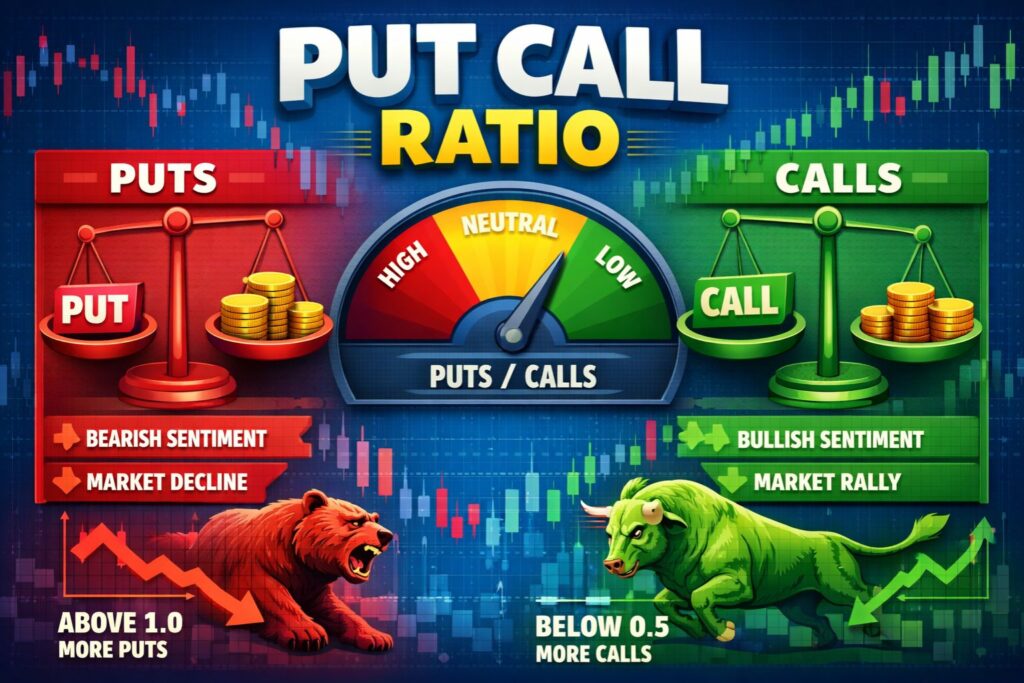
Put-Call Ratio: An introduction
The Put and Call Ratio is an indicator of market sentiment calculated from options data. It shows the ratio of put options contracts to call options contracts and helps a trader determine the extent of bearish or bullish market sentiment. It can be very useful for a trader to learn from the application of the Put and Call Ratio in trading and avoid making emotionally driven decisions.
What is Put Call Ratio?
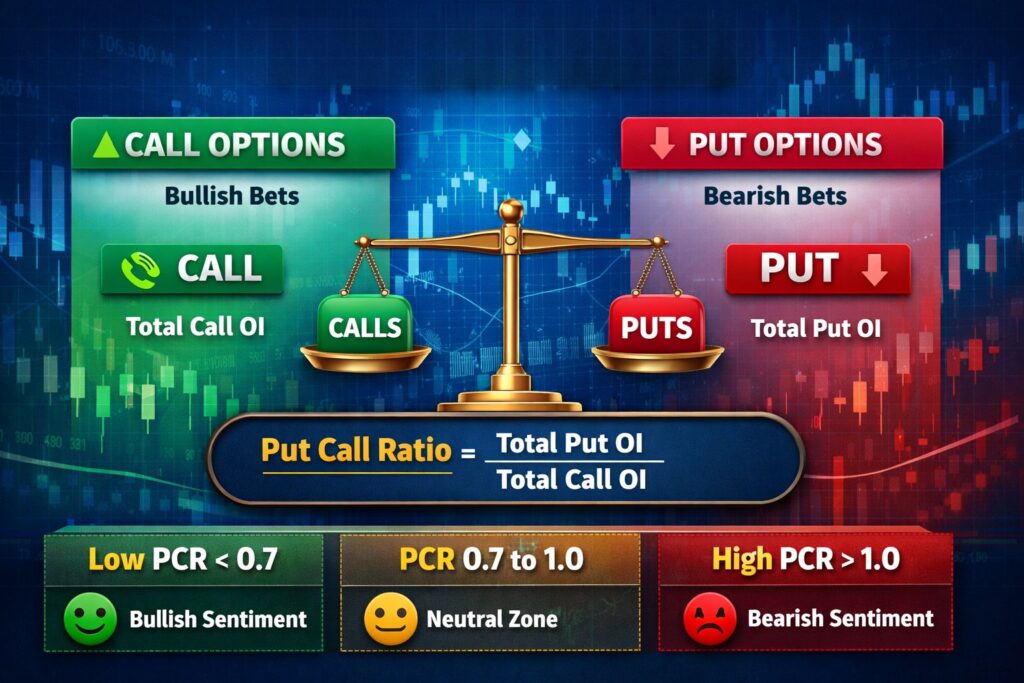
Put Call Ratio is calculated by dividing total Put Open Interest by total Call Open Interest.
Formula:
- Put Call Ratio = Put OI ÷ Call OI
This simple formula provides deep insight into market behaviour. Understanding how the Put Call Ratio is used in trading helps traders to stay ahead, expecting a potential change in trend rather than late reactions.
There are two major types:
- OI-based PCR was most reliable for positional trading.
- Volume-based PCR, Lesser intraday sentiment
Why the Put-Call Ratio Matters in Trading
The most important benefit of PCR is the fact that it reflects what smart money is doing. Institutions often build positions quietly in options. By analysing how the Put Call Ratio is used in trading, retail traders can align themselves with institutional behaviour.
PCR does not predict price directly, but it shows sentiment, which often leads to price movement.
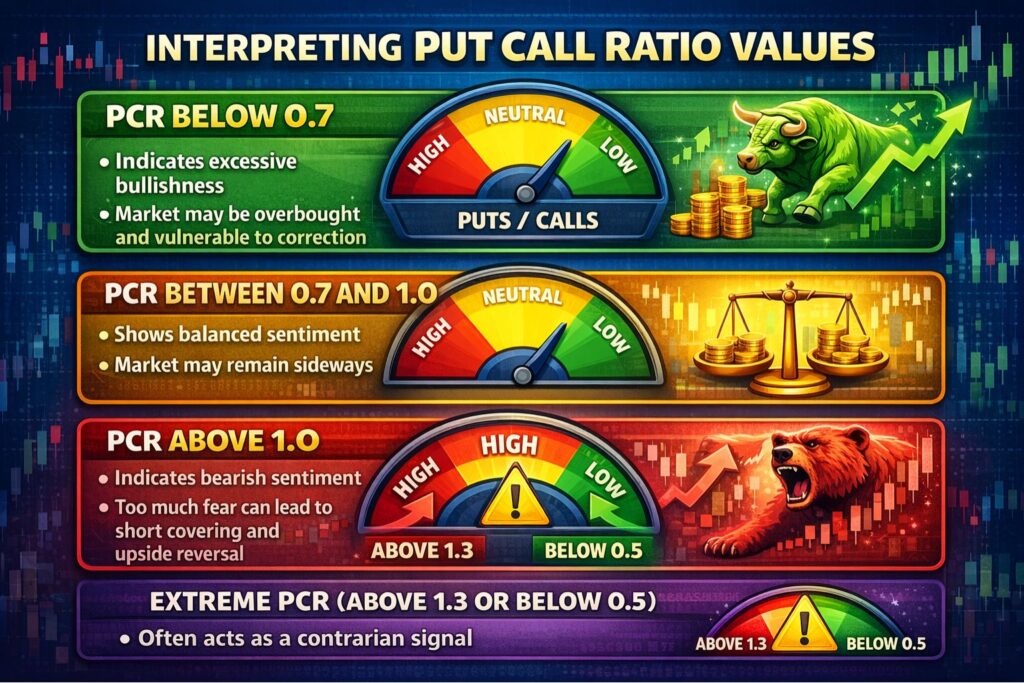
Interpretation of Put Call Ratio Values
To completely understand the use of the Put Call Ratio in trading, traders must know how its levels are interpreted.
- PCR below 0.7
Indicates excessive bullishness the market may be overbought and hence open to correction.
- PCR between 0.7 and 1.0
Shows balanced sentiment. The market may remain sideways.
- PCR Above 1.0
It shows bearish market sentiment. Fear in excess could cause short sale unwinding and market turn around.
- Extreme PCR (above 1.3 or below 0.5
Frequently used as a contrarian indicator.
The above explanation clearly demonstrates how the Put-Call Ratio is employed in trading based on its sentiment-related function.
Put Call Ratio as a Contrarian Strategy
An essential part of learning about the application of the Put-Call Ratio in trading involves understanding its contrarian characteristic. When the majority of traders are bearish, the markets tend to bottom out. When they are generally bullish, markets tend to peak.
- High PCR = Too many puts = Fear
- Low PCR = Too many calls = Greed
Smart traders trade against extreme sentiment, not with the crowd.
Using Put-Call Ratio with Option Chain Analysis
PCR becomes more powerful when combined with option chain data. To understand how the Put Call Ratio is used in trading, traders analyse:
- Highest Call OI (Resistance zone)
- Highest Put OI (Support zone)
- Change in OI along with PCR movement
For example, rising PCR with increasing Put OI near support often signals strength, not weakness.
Put Call Ratio with Technical Analysis
PCR should never be used alone. Professional traders know how to use the Put Call Ratio while trading, in conjunction with technical indicators like:
- Trendlines
- RSI Divergence
- Moving averages
When the technical signals are in sync with the PCR sentiment, it considerably improves the accuracy of the trade.
Put-Call Ratio in Intraday Trading
Intraday traders use volume-based PCR for fast changes in sentiment. Understanding how the Put Call Ratio is used intraday in trading helps in:
- Identifying False Breakout
- Steer clear of trap trades.
- Confirming intraday trend strength
However, the intraday PCR is highly volatile and should therefore be used cautiously.
Put Call Ratio in Positional and Swing Trading
It is more reliable in the case of OI-based PCR for swing and positional traders. Many professionals rely on how the Put Call Ratio is used in trading for weekly and monthly expiry analysis.
A stable PCR at important support/resistance levels indicates a pending direction.
Common Mistakes of PCR Usage by Traders
A lot of people make the following mistakes while using the Put-Call Ratio in their trading:
- Trading based only on PCR
- Ignoring price action
- Assuming reversal at extreme levels
- Without reference to market news or events.
- PCR indicates market sentiment, not market timing.
Limitations of Put Put-Call Ratio
Even though it is powerful, traders must respect the limitations while learning how the Put Call Ratio is used in trading:
- PCR can stay extreme for long periods
- It does not give exact entry or exit points.Needs confirmation of price and volume
- This is why professional traders also use PCR as a second indicator.
Risk Management during Usage of the Put-Call Ratio
Risk management is a must. To comprehend the application of the Put-Call Ratio in trading also involves understanding when to withdraw from a losing trade.
Always:
- Use stop loss
- Practicing proper position sizing.
- Avoid Over-lever
- Sentiment may shift rapidly in derivative markets.
Final Conclusion
In conclusion, the application of the Put Call Ratio in trading is more focused on market psychology rather than pinpointing market prices. By analysing market psychology using PCR, a trader can gauge market greed, market fear, and turn around. By incorporating analysis tools such as the option chain and various technical parameters, PCR becomes a perfect trading solution.
Instead of blindly following tips, traders who master how the Put Call Ratio is used in trading gain a long-term edge in the market. It is not a magic formula but a powerful lens to see what the majority opinion is and trade smarter than them.
Frequently Asked Questions (FAQs)
Q1. What is Put Call Ratio in Trading?
The Put Call Ratio, commonly known as PCR is a market sentiment indicator that studies the relationship between the total number of put options and call options. This helps the traders to understand whether the bearish or bullish sentiments dominate the market.
Q2. How is the Put Call Ratio used in trading?
How the Put Call Ratio is used in trading mainly involves analysing market sentiment, identifying overbought or oversold conditions, and spotting potential trend reversals when the PCR reaches extreme levels.
Q3. Which is the best Put Call Ratio for trading OI or Volume-based?
The OI-based Put Call Ratio is good to follow for positional and swing trading, whereas the volume-based PCR will be useful for intraday sentiment analysis.
Q4. What is a good Put-call Ratio for a bullish market?
The Put-call ratio of below 0.7 normally indicates bullish sentiment, while extremely low values also show overconfidence in the market and hint toward a correction.
Q5. What does a high Put-Call Ratio indicate?
A high Put Call Ratio above 1.0 depicts bearish sentiment. However, very high PCR acts as a contrarian signal leading to the reversal of the market.
Q6. Does the Put-Call Ratio indicate the exact direction in the market?
No, the Put Call Ratio is not a predictor of the exact price movement. It reflects only the market sentiment. The trader needs to combine the PCR with price action option chain analysis and technical indicators.