
If you have ever wondered how to grow your wealth, financial freedom, and make money work for you, then learning how to start trading in the Indian stock market is the first big step. The Indian stock market offers endless opportunities to those who are ready to understand its structure, build strategies and trade with discipline. But before you jump into it a clear roadmap is needed. This blog will lead you step by step on how to start trading in the Indian stock market the right way.

Understand what the stock market is
Basically, to know how to start trading in the Indian stock market, one needs to understand what exactly the stock market does. It is a place where buyers and sellers trade ownership in publicly listed firms. In India, there are two major stock exchanges, namely: National Stock Exchange and the Bombay Stock Exchange.
Each company listed on these exchanges issues shares, and traders buy or sell these shares based on the fluctuation in prices. Prices fluctuate due to supply and demand, company performance, and global economic events. The fundamentals behind it all are important to understand before you further yourself into how to start trading in the Indian stock market.
Learn the Basic Concepts
Before you open any account, you must learn some basic stock market terms. You’ll often hear words like bull market, bear market, IPO, dividend, stop-loss, and volatility.
- Besides that, to master how to start trading in the Indian stock market, one must know the difference between trading and investing.
- Investment focuses on holding stocks for years to create wealth over the long term.
- On the other hand, trading is specifically about making short-term gains through price changes.
The market also comprises several segments like equity, derivatives, and commodities, and knowing the way each of them works will make it even easier to make better decisions.
Set Clear Financial Goals
A step in how to start trading in the Indian stock market is setting realistic financial goals. Ask yourself why you want to trade. Are you looking for a side income, a full-time career, or just to grow your savings?
When you are clear about everything, define your risk appetite. Stock markets work on the principle of profit and loss; the main thing is how to keep your emotions in check. Never risk money that you cannot afford to lose. Experts suggest starting small and growing gradually with experience.
Open your Demat and Trading Account
To start trading legally in India you have to open three accounts:
- Bank Account: to transfer funds.
- Demat Account – to hold the shares in digital form.
- Trading Account – to execute purchase and sell orders.
One of the most practical steps to Learn Stock Market Trading in India is the opening of a demat and trading account. You can open these accounts with a registered broker such as Zerodha, Upstox, Angel One or Groww.
While choosing a broker, compare brokerage charges, trading platforms, customer service, and user experience. Most brokers nowadays provide easy online KYC verification, and the process hardly takes a few minutes.
Choose Your Trading Style
Once your account has been activated, determine your trading style. There is more than one way to trade:
- Intraday Trading – buying and selling on the same day.
- Swing Trading: Holding positions for a few days to capture short-term trends.
- Positional Trading – holding for weeks or months.
- Scouting-earning through small quick trades numerous times a day.
Each style possesses its own risk-reward ratio. Knowing these styles is important in learning how to start trading in the Indian stock market, as it will dictate how one will manage his time, emotions, and capital.
Learn Technical and Fundamental Analysis
Knowledge is your big weapon to succeed in trading. It will be more effective to learn how to start trading in the Indian stock market through both technical and fundamental analysis.
Technical analysis focuses on charts, price patterns, and indicators like RSI, MACD and moving averages. It helps identify entry and exit points.
It examines the performance of the firm, considering its profit, revenue, debt, management and industry growth to determine if the stock is worth buying.
Both combined give a trader a balanced and confident approach in trading decisions.
Create a solid trading plan.
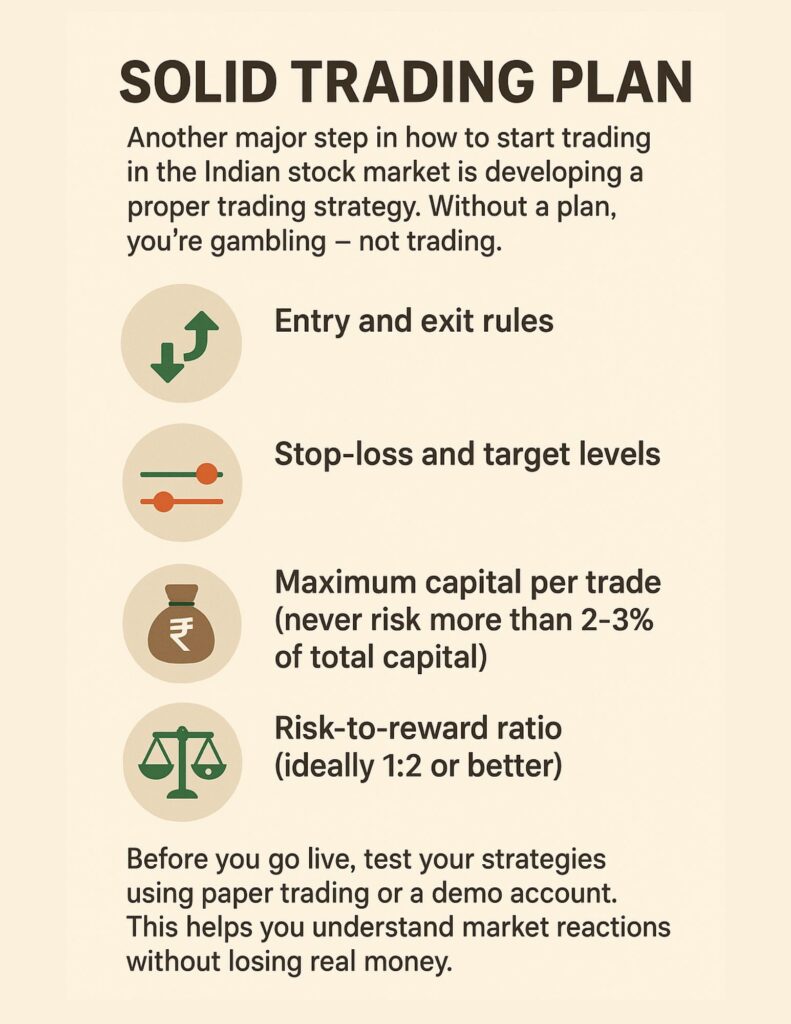
Another major step in how to start trading in the Indian stock market is the development of a proper trading strategy. Without a plan, you’re gambling, not trading.
Your plan should include:
- Entry and exit rules
- Stop-loss and target levels
- Maximum capital per trade: never risk more than 2–3% of the total capital
- Risk-reward ratio – ideally 1:2 or better
Test your strategies with paper trading or a demo account before going live. That way, you will get to understand how markets react without the loss of real money.
Keep yourself updated with market news.
The Indian market is highly sensitive to news-from government budgets to global events. Staying informed stands out as one of the crucial facets of how to go about trading effectively in the Indian stock market.
Follow Economic Times, Moneycontrol, and NSE India daily for updates. Economic indicators like inflation, interest rates, and foreign investment inflows have direct impacts on stock movements.
Start Small and Keep Learning
No matter how much you study, real learning begins once you start trading. Start with a small capital and gradually increase it. Keep a trading journal of your decisions, profits and mistakes. It helps you improve much faster because you review regularly.
If you are serious about learning the skills required to start trading in the Indian stock market, consider joining a professional institute like the IISMT. Institutes like IISMT will offer you live market practice, mentorship by experts, and structured learning programs that assist you in trading with confidence and smartly.
Common Mistakes to Avoid
Following are some of the common mistakes that one should not commit while learning how to start trading in the Indian stock market:
- Trading without a stop-loss.
- Chasing every stock that moves.
- Depending on tips or paid signals.
- Allowing one’s feelings to take over and make decisions.
- Ignoring proper research.
Avoiding these mistakes will save you from heavy losses and make you grow as a disciplined trader.

Conclusion
Now that you have learned how to start trading in the Indian stock market, it’s actually time to take up the challenge, but with caution and preparedness. The stock market is not a shortcut towards wealth; it’s a skill-based journey that gives rewards to patience, consistency, and knowledge.
It starts with education, then regular practice, and trading with discipline. Be it part-time or full-time, learning how to start trading in the Indian stock market is one of the most essential factors that will get you closer to being a successful trader.