Understanding the impact of FII and DII on Market Volatility is an important skill for everyone who wants to survive and grow in the stock market. Many retail traders focus solely on charts and indicators, but they often overlook the real force that drives the market large institutional money. When Foreign Institutional Investors (FIIs) and Domestic Institutional Investors (DIIs) enter or exit the market, volatility automatically increases. This blog will help you understand how and why that happens and how you can use this knowledge to trade or invest more intelligently.
Introduction: Why Institutional Money Matters
The stock market does not move randomly. Behind every sharp rally, sudden fall, or sideways phase, there is a strong reason and most of the time, that reason is institutional buying or selling. The impact of FII and DII on Market Volatility becomes visible during events such as global crises, interest rate changes, or major economic disclosures. Retail traders may panic during such phases, but institutions plan their moves much earlier.
Volatility is not bad; it simply represents opportunity and risk. If you understand the FII and DII Impact on Market Volatility, you stop reacting emotionally and start trading with logic and data.
Who Are FIIs?
Foreign Institutional Investors are large investment entities based outside India that invest in Indian financial markets. These include hedge funds, foreign mutual funds, pension funds, sovereign wealth funds and global banks.
FIIs usually manage massive amounts of capital. Because of this size, even a small percentage shift in their portfolio allocation can create sharp price movements. The main motive for the impact of FII and DII on Market Volatility in India.
This makes the FIIs highly sensitive to:
- Interest rates globally, especially US Fed decisions
- Currency movements (USD-INR)
- Geopolitical tensions
- Global market risk sentiment
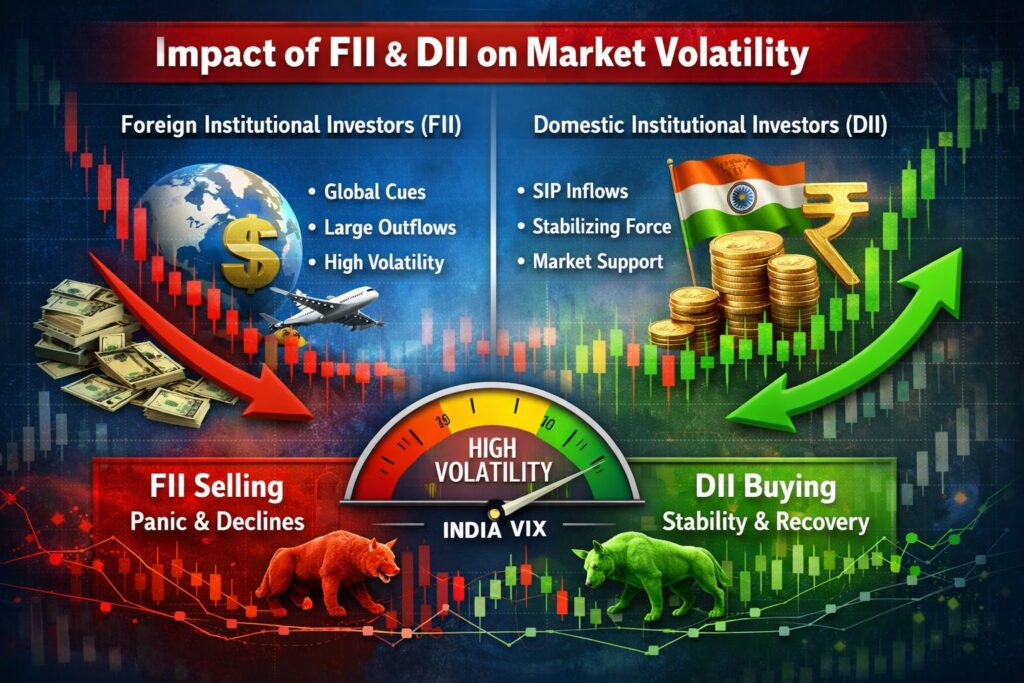
When FIIs become aggressive buyers, markets rally strongly. When heavy selling takes place, markets panic and become very volatile.
Who Are DIIs?
Domestic Institutional Investors: Domestic Institutional Investors are institutions within India itself. They consist of Indian Mutual Funds, Insurance Companies, Banks, EPFO, and Pension Funds.
DIIs usually take a long-term perspective, which differs from that of FIIs. Their investments are made based on domestic economic expansion, SIP, and creating long-term wealth. The impact of FII and DII on Market Volatility becomes interesting when DIIs remove the selling pressures by FIIs.
In recent years, strong SIP inflows have made DIIs a powerful stabilising force. In market corrections, purchases made by DIIs can help alleviate volatility and function as a support factor for the market structure during that phase.
What is Market Volatility?
Volatility can be defined as the rate at which prices change in the market. High volatility indicates extreme fluctuations in prices, while low volatility indicates stable market behaviour.
The impact of FII and DII on Market Volatility is mostly open in:
- Economic systems
- Event-driven trading sessions
- Global risk-on or risk-off environments
India VIX, ATR, and volume expansion are some indicators for the measurement of volatility. Whenever institutions act aggressively, these indicators spike.
How FIIs Increase Market Volatility
FIIs are the biggest drivers of short-term volatility. The impact of FII and DII on Market Volatility increases when FIIs:
- Sell heavily due to global risk-off sentiment.
- Shift money from emerging markets to developed markets.
- React to rising bond yields or dollar strength.
Since FIIs participate heavily in derivatives, their futures and options positions can amplify market moves. This may lead to a single day of heavy FII selling breaking key technical levels and triggering stop-losses across the market.
How DIIs Control and Reduce Volatility
While the FIIs mostly increase volatility, DIIs act as shock absorbers. The impact of FII and DII on Market Volatility is stable when DIIs take a step into the market.
DIIs:
- Buy quality stocks during dips.
- Support indices through long-term investments
- Reduce panic selling by providing liquidity.
However, DIIs cannot always stop volatility completely. They slow down the fall but cannot reverse a strong global-driven selloff immediately.
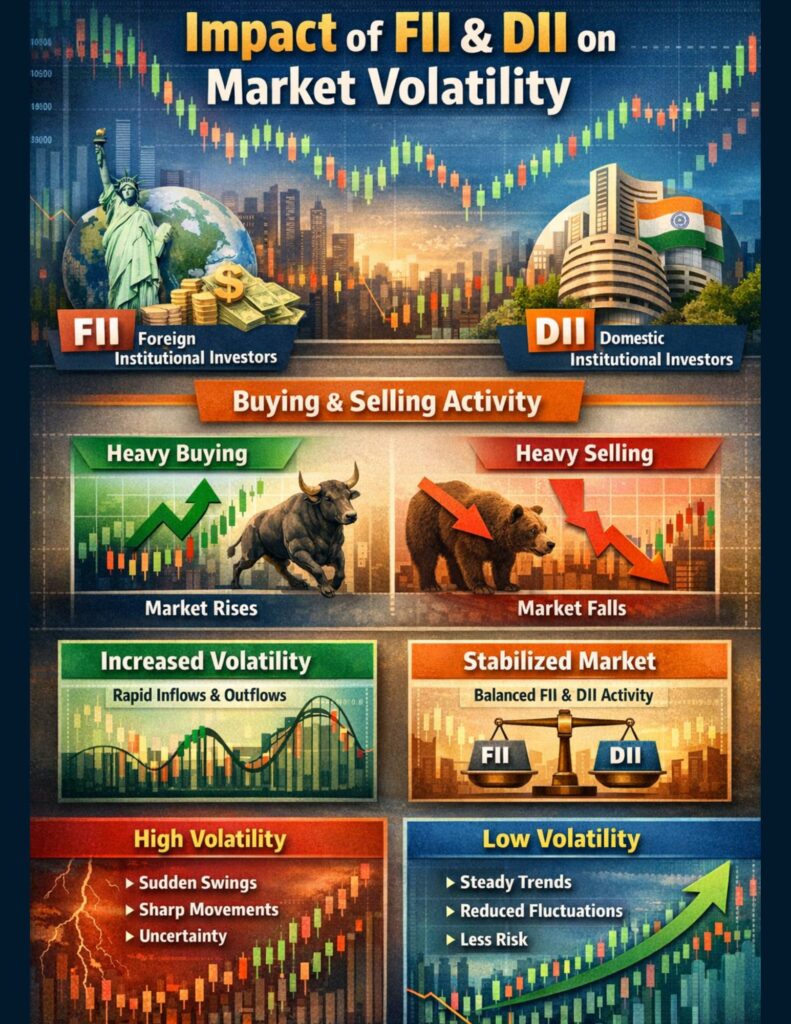
FII vs DII: Who Dominates Market Volatility?
The impact of FII and DII on Market Volatility changes based on the nature of the market. For the short term, FIIs lead the way owing to their pace and volume. For the long term, the DIIs lead in establishing a solid foundation for the market.
Historically:
- Market crashes are mostly triggered by FII selling.
- Market recoveries are supported by DII accumulation.
- When both FIIs and DIIs buy together, markets enter a strong bullish phase with controlled volatility.
Key Data Traders Should Track
Understand the impact of FII and DII on Market Volatility, traders must track:
- Daily FII and DII cash market data
- Index futures long-short ratio
- Options open interest changes
- India VIX movement
- Sector-wise institutional allocation
One-day data should never be used in isolation. Trends over multiple days give more reliable signals.
Impact on Intraday Traders
For intraday traders, the impact of FII and DII on Market Volatility creates both opportunity and danger. High volatility translates into quick profits as well as quick losses.
During heavy institutional activity:
- Non-actual breakouts remain
- “Stop-loss hunting” emerges as a
- “Position Sizing” becomes important.
Day traders have to limit their size and rely on price and volume confirmations.
Effect on Swing Traders & Investors
A swing trader can control the impact of FII and DII on Market Volatility, not to trade opposing the market trend. Aggressive FII sales can cause postponements in breakouts, while steady DII purchases build quality support.
For long-term investors, volatility created by FIIs often becomes an opportunity. Smart investors accumulate quality stocks when fear dominates the market.
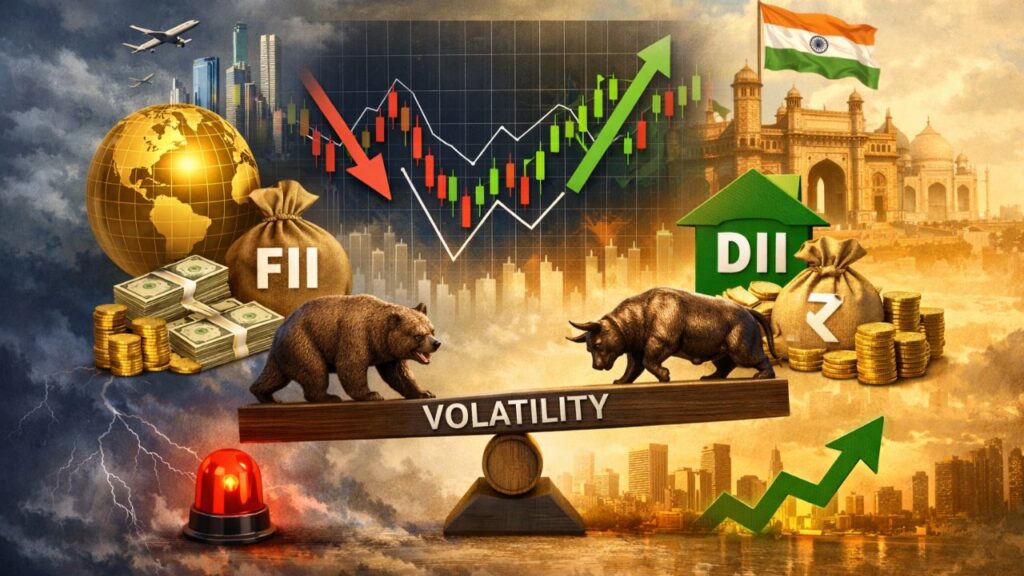
Trading & Investment Strategies
The impact of FII and DII on Market Volatility, what can traders do in the stock market:
- Trading in the direction of institutional flow
- Be less aggressive during uncertain phases.
- Add data from FII-DII to the technical analysis.
- Emphasis on Risk Management over Prediction.
Markets are characterised by rewards for patience and discipline as opposed to emotional behaviour.
Common Myths About FII and DII Data
Many traders misunderstand the impact of FII and DII on Market Volatility due to myths such as:
- FIIs are always right.
- DII buying means the market bottom
- One-day data predicts market direction.
In fact, institutional data is best integrated with market price activity, market trends, and broader economic trends.
Real Market Examples
During major global events like pandemics or crises in the global economy, the impact of FII and DII on Market Volatility becomes more pronounced. FIIs tend to immediately withdraw from markets to safeguard global portfolios. Then DIIs absorb the pressure gradually.
Such a pattern has been witnessed many times in the history of the Indian markets.
Conclusion
The impact of FII and DII on Market Volatility is a reality that no serious trader or investor can ignore. FIIs create momentum and sharp moves, while DIIs provide stability and long-term strength. Understanding this relationship helps you stay calm during market chaos and make smarter decisions.
Instead of fearing volatility, learn to read institutional behaviour. When you trade with awareness of institutional flow, the market stops looking unpredictable and starts making sense.