
In the recent past, the Indian stock market has grown at a rapid pace, and NSE derivatives trading is one of its most dynamic segments, attracting both amateur and experienced traders. Derivatives allow traders to speculate on the future price movements of stocks, indices, commodities, and currencies without actually owning the underlying asset. It is this flexibility that has made NSE derivatives trading one of the most powerful tools for hedging, speculation, and risk management in the present scenario.
After going through this blog, you will learn everything about NSE derivatives trading: what it is, its types, its benefits, strategies, margin requirements, and how you can get started safely.
What is NSE Derivatives Trading?
To understand NSE derivatives trading you must first know what derivatives are. A derivative is a financial contract, the value of which is derived from an underlying asset like Nifty 50, Bank Nifty, Reliance, Infosys, gold, crude oil and currency pairs. NSE has a wide variety of such derivative products that traders can use either for hedging or in order to make a profit out of the fluctuation in prices.
In other words, How Derivatives Influence Stock market simply means you are buying or selling futures and options based on your expectations of future price movements.
Types of Derivatives Available on NSE
The two main instruments employed for NSE derivatives trading are:
1. Futures Contracts
A futures contract is an agreement to buy or sell an underlying asset at a pre-defined price at a future date. Futures are standardised, traded on the exchange, and have fixed contract sizes and expiry dates.
Example:
You can buy a Nifty futures contract if you expect the Nifty to rise next month.
2. Options Contracts
Options confer the right but not the obligation to buy or sell an asset at a particular price before the expiration of the contract. The options are available in two forms:
- Call Option (CE) – Right to buy
- Put Option (PE) – Right to sell
Options give traders the opportunity to profit from up and down movements, with limited risk.
Within NSE, derivative trading includes both futures and options, making the trading on the market highly versatile.
Why Is NSE Derivatives Trading So Popular?
Its popularity reflects several advantages of NSE derivatives trading not possible in equity or cash trading.
1. Leverage
With derivatives traders can take large positions with a smaller capital. This is due to margin requirements, which allow you to control high-value contracts.
2. Hedging
Investors use derivatives to protect their portfolios from sudden market movements. For example, if you fear that the market will fall, you can short futures or buy put options to reduce risk.
3. Higher Profit Potential
Price swings in the derivatives market create opportunities for intraday, positional, and swing trades.
4. Flexibility
Traders can use multiple strategies depending on market direction: bullish, bearish, range-bound, or volatile markets.
These advantages make NSE derivatives trading suitable for traders who want accuracy and control.
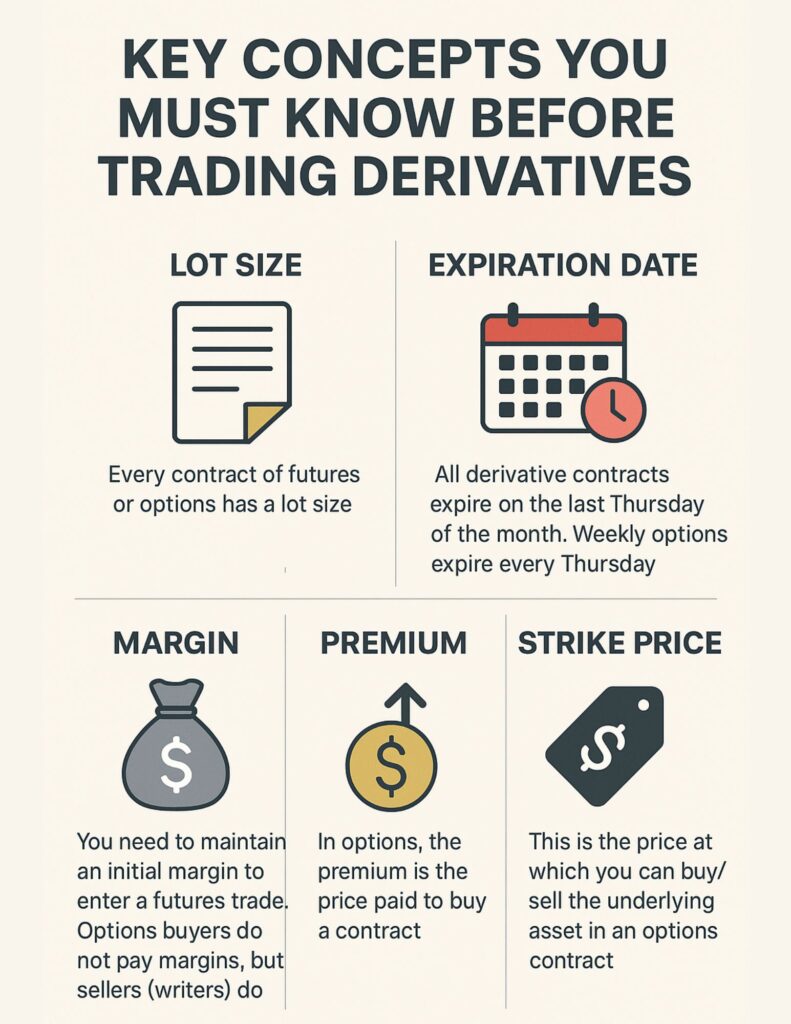
Key Concepts You Must Know Before Trading Derivatives
To trade efficiently, you have to know a few key concepts used in NSE derivatives trading.
1. Lot Size
- Every contract of futures or options has a lot size. For example the lot size for Nifty is 25, and that of the Bank Nifty is 15.
2. Expiration Date
- All derivative contracts expire on the last Thursday of the month. Weekly options expire every Thursday.
3. Margin
- You need to maintain an initial margin to enter a futures trade. Options buyers do not pay margins, but sellers (writers) do.
4. Premium
- In options, the premium is the price paid to buy a contract.
5. Strike Price
- This is the price at which you can buy/sell the underlying asset in an options contract.
These terms need to be understood for proficiency in NSE derivatives trading.
Popular Strategies Utilised in NSE Derivatives Trading
Success in the derivatives market is never possible without using appropriate strategies. The following are some commonly used techniques:
1. Directional Trading
It involves predicting the market’s upside or downside and hence taking positions in that direction.
2. Hedging Strategies
Portfolio hedgers use futures and options to reduce risk.
Example:
Buying a put option to protect a long-term investment portfolio.
3. Option Selling Strategies
These include short straddles, short strangles, iron condors, and covered calls. Skilled traders use them to earn a regular income from time decay.
4. Spread Strategies
Traders use bull call spreads, bear put spreads, and calendar spreads to lower risk and increase the probability of profit.
All these strategies demonstrate the scope and depth of NSE derivatives trading.
Risk Management in NSE Derivatives Trading
Whereas derivatives can offer high profit potential, they also come with significant risks if not managed properly.
Risk management rules include the following:
- Never use all your capital in one trade.
- Set stop-loss and follow risk reward ratios.
- Use hedged strategies if you are a beginner.
- Avoid over-leveraging
- Track current global and domestic news events that drive the market.
One needs to be very disciplined while trading in NSE derivatives, particularly when the volatility is high.
Who Should Consider NSE Derivatives Trading?
Derivatives are ideal for:
- Traders are looking for higher returns.
- Investors who want to hedge their portfolios
- People who understand market trends and data
- Intraday and swing traders
- Experienced traders looking to diversify trading styles.
Even beginners can trade in NSE derivatives, but they should start with small positions and proper training.
How to Start NSE Derivatives Trading
Here’s a step-by-step guide to get you started:
1. Open a Trading & Demat Account
Choose a broker registered with SEBI offering NSE F&O trading.
2. F&O Activation Completion
You have to submit income proof to enable F&O trading.
3. Learn the Basics
Knows futures, options, margin, option Greeks and market structure.
4. Start with Paper Trading
These strategies should be expert first through virtual trading.
5. Trade with Strict Risk Management
Start small and slowly scale up as confidence builds.
The steps above will facilitate a smooth passage into NSE derivatives trading

Conclusion:
Trading in derivatives through the NSE represents one of the most powerful means of participating in Indian financial markets. From hedging ones investments to trading in market volatility and constructing long-term strategies, derivatives offer unparalleled flexibility. Success here is all about knowledge, discipline and continuous learning.
With proper guidance and practice anyone can master NSE derivatives trading and use it as a stepping stone toward a very rewarding trading career.