Introduction
Stock market performance can never remain constant, so it swings between highs and lows, often in unpredictable ways. This unpredictability is what we refer to as volatility in the stock market. For traders and investors, volatility can be a threat but also, together,an opportunity. On the other hand, derivative financial instruments that derive their value from underlying assets represent powerful tools to manage, predict, or even profit from this very volatility.
This article examines the deep inter-reliance between Stock Market Volatility and Derivatives, the way they influence each other, and why it is essential to know this relationship for good trading and risk management.
What is Stock Market Volatility?
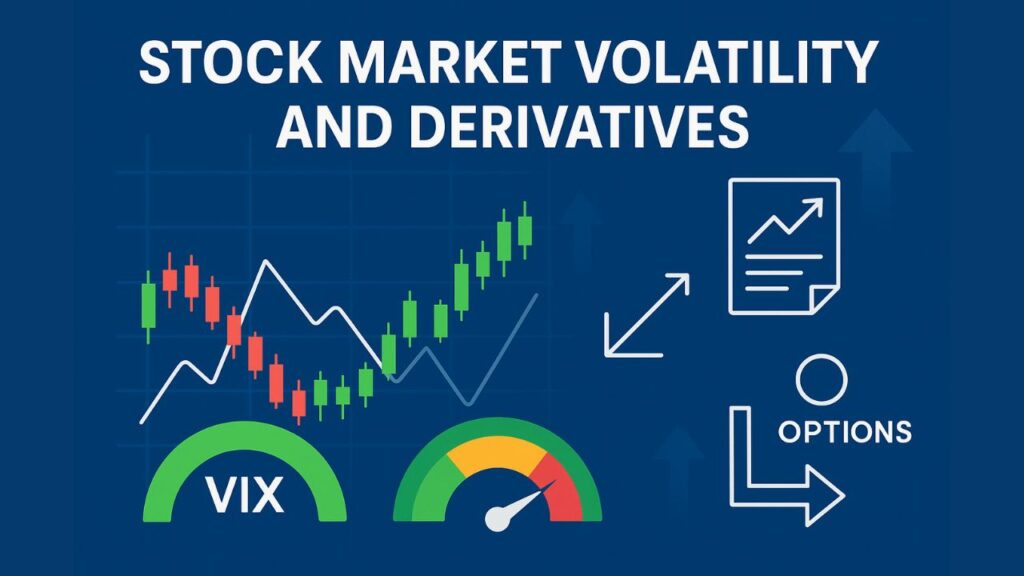
Stock Market Volatility and Derivatives is the speed at which the prices of securities increase or decrease within a certain period. High volatility involves in prices, while low volatility means the market is relatively stable.
The two main types of volatility are:
- Volatility: it represents the movement of stock prices in history.
- Implied volatility: refers to the expectations of the market concerning future changes in prices, which are usually inferred from options pricing.
India VIX is an index widely used in India, indicating the market volatility for the next 30 days. When the India VIX increases, it reflects that traders expect more price swings the market is nervous or uncertain.
Conventionally, budget announcements, elections, global conflicts, and changes in monetary policy have been considered the major high-volatility events for stock markets.
What are Derivatives?
A derivative is a financial contract that derives its value from an underlying asset, which may include stocks, indices, or commodities. Derivatives have wide applications in hedging, speculation, and arbitrage.
The main types of derivatives are:
- Futures: An agreement to sell or buy an underlying asset at a prespecified price at some time in the future.
- Options: Give the right but not the obligation to buy or sell an asset at a specified price.
- Forwards: Customised contracts between two parties, not traded on exchanges.
- Swaps: Agreements to exchange cash flows or financial instruments between two parties.
These instruments are traded on stock exchanges like the NSE and BSE in India, helping investors manage the risk that comes from stock market volatility and derivatives movements.
The Relationship Between Stock Market Volatility and Derivatives
The relations between stock market volatility and derivatives are complex and interrelated. Volatility, which determines the pricing of derivatives, and the use of derivatives, in turn, can produce market volatility.
Volatility affects the prices of all types of derivatives:
- Implied volatility is the single most important factor in determining option premiums in the options market.
- Options have higher value when volatility is high as their likelihood of making a price swing that would realize the option profitably increases.
- options are more expensive when the volatility of the stock market is high.
Derivatives influence market volatility:
- High volumes of derivative trading lead to rapid market responses.
- Large over-the-counter positions in futures and options magnify market movements when traders begin to unwind positions en masse.
- This means that undue speculation through derivatives sometimes surges the overall volatility in stock markets.
Stock market volatility and derivatives are thus two sides of the same coin. Each influences and is responsive to the other.
How Derivatives Help Manage Volatility
While volatility might sound scary, it is nothing more than an opportunity to manage or even profit from derivatives. Here’s how traders use them to great effect
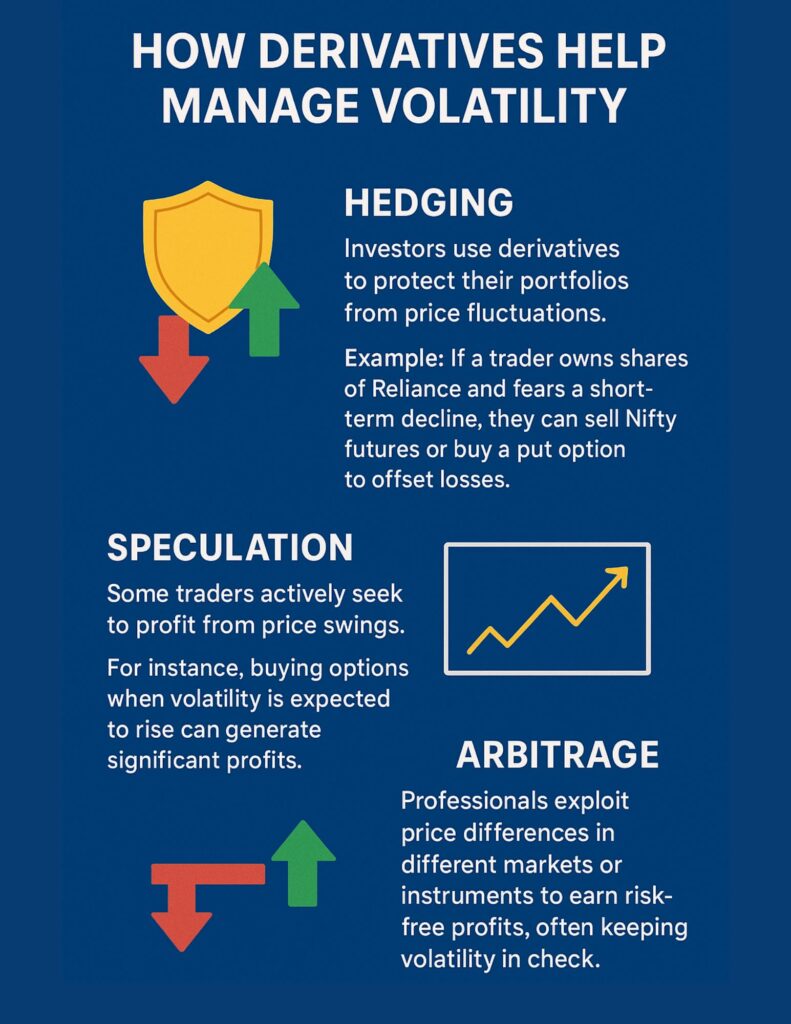
Hedging:
- Investors hedge their portfolios against price volatility with derivatives.
- A trader holding onto Reliance shares, anticipating the fall of the stock price in the short term, can sell Nifty futures or buy a put option to offset the losses.
- This investment approach stabilizes returns in the high volatility period of stock markets.
Speculation:
- Some traders trade actively and earn profit due to price swings. They speculate on the rise or fall in volatility through options or futures. In fact, buying options when volatility is expected to increase yields significant profits.
Arbitrage
- Professionals take advantage of price discrepancies in various markets or instruments to generate returns free of risk, many times maintaining volatility at low levels.
These strategies will enable participants to better face the tough environment brought about by stock market volatility and derivatives.
How Derivatives Contribute to Market Stability or Instability
There are two schools of thought about whether derivatives stabilise or destabilise the stock market.
Stabilising Role:
- Derivatives provide tools for risk management.
- They allow investors to hedge exposure and maintain market liquidity.
- This reduces panic selling and smoothes price discovery.
Destabilising Role:
- When excessive speculation is mixed with high leverage, the result is sharp market crashes.
- Large derivative positions could be one of the causes for these mass liquidations during big events and further spread volatility across stock markets.
Consequently, derivatives can decrease risk when used appropriately, yet they increase losses greatly when handled poorly.
Case Studies: When Volatility and Derivatives Interacted
2008 Global Financial Crisis:
Global increased volatility was a result of over-leveraged derivative instruments, including debt backed securities.
Worldwide, markets crashed to show just how dangerous misused derivatives could be.
COVID-19 Market Crash (2020):
Uncertainty soared with the India VIX reaching historic highs.
Options were used either to hedge against losses or to speculate on extreme moves by derivatives traders.
Indian Election Periods:
The volume of derivatives trading surges as traders bet on political outcomes.
This short-term speculation increases stock market volatility and derivatives activity simultaneously.
This examples show how global and domestic events intertwine with volatility derivative market reactions.
Managing Derivative Trading Risks during Turbulent Markets
Derivatives trading in India during times of volatility requires discipline and risk management. Key practices include the following
- Limit downside risks by placing stop-loss orders.
- Avoid overleveraged positions.
- Keep eye on India and suggest volatility prior to trading.
- The method does not depend on one direction.
- Track news of international and financial events that may increase volatility.
Adequate knowledge about stock market volatility and derivatives ensures that traders don’t get trapped by sudden market swings.
Conclusion
The core of modern trading is the relationship between stock market volatility and derivatives. Where there’s volatility, there’s opportunity, but there’s also risk-and the instruments for conducting both are called derivatives. Whether you are a hedger, speculator, or arbitrageur, the ability to understand how volatility affects derivative pricing and vice versa is the key to your success.
Stock Market Volatility and Derivatives are not enemies but partners; each one plays a different rhythm of the market movements. Those who master this relationship can turn market uncertainty into a powerful advantage.