
If you want to succeed in the stock market, understanding how to build a Complete Trading System is not optional it’s essential. Most beginners enter the market with random trades, tips from friends, or social media signals. The result? Losses, frustration and confusion.
A well-structured trading system acts like a roadmap. This will help remove your emotions, develop discipline, and assist you in making logical decisions as opposed to impulsive ones.
In this tutorial, we will walk you through the process of constructing your very own Complete Trading System.
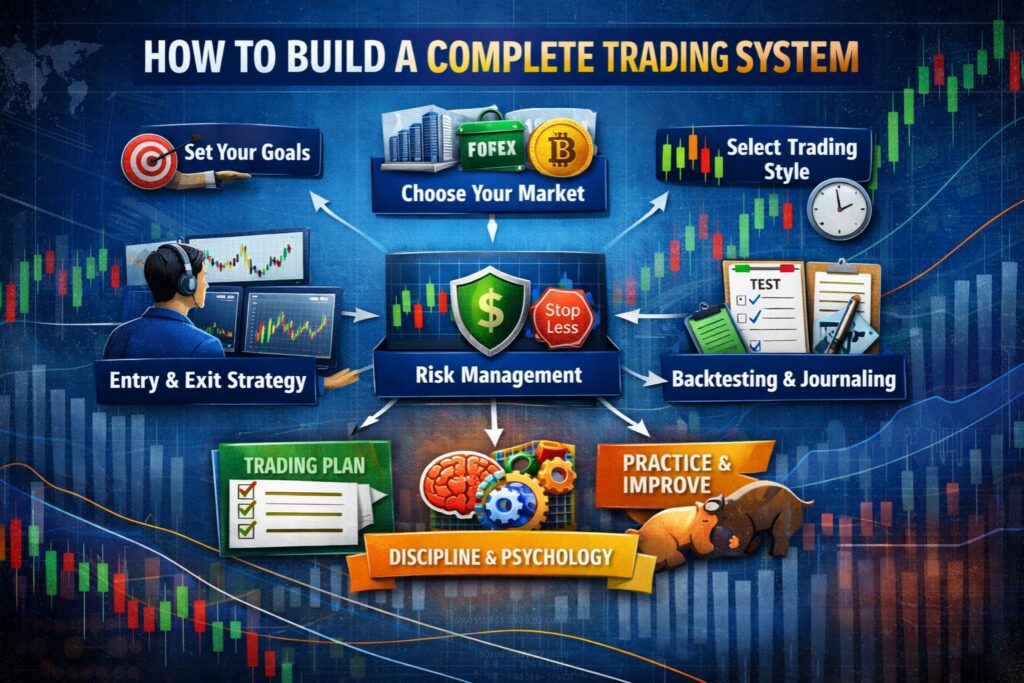
What is a Complete Trading System?
Prior to discussing the construction of a Complete Trading System, it is necessary for us to comprehend its meaning.
A trading system refers to a series of rules that dictate:
- When to buy an asset
- When to sell an asset
- The amount of risk involved
- The proper management of one’s capital
The absence of such a system leads to gambling, whereas the presence of a system makes trading a business endeavour.
Step 1: Define Your Trading Goals
The first step in How to Build a Complete Trading System is clarity.
Ask yourself:
- Are you trading for daily income or long-term wealth?
- What is your risk patience level?
- How much capital can you afford to lose?
- A student would probably opt for smaller, safer trades whereas a professional would look forward to higher profits.
This would define your whole trading system.
Step 2: Selecting the Right Market
Selecting the right market is another crucial element of How to Build a Complete Trading System.
Some of them are:
- Stock Market
- Foreign Exchange Market (Forex)
- Cryptocurrency
- Commodity
- Each market has unique features The stock market is simple for novice traders due to its transparency and regulation.
Choose a market that matches your skills and experience.
Step 3: Choosing a Trading Style
Your trading style show how often you trade. When learning how to construct your own Complete Trading System, this step is extremely important.
Some popular styles are:
- Intraday Trading (trades within the day)
- Swing Trading (hold positions for days or weeks)
- Positional Trading (long-term holding)
- Scalping (short-term trades)
If you have a full-time job swing trading might suit you better than intraday trading.
Step 4: Create an Effective Entry Strategy
An important factor in How to Build a Complete Trading System is determining precisely when to enter into a trade.
Your entry strategy may be based on:
- Technical indicators (RSI, MACD, Moving Average)
- Price behavior (support and resistance)
- Breakout patterns
- Confirmation of trend
- For instance, your strategy could be:
- “Enter a trade if RSI is under 30 and price is at support.”
The clearer your rules, the better your system.
Step 5: Create an Exit Plan
While most traders pay attention to entry alone, the importance of exit plans becomes much more critical in developing a Complete Trading System.
Your exit strategy should include the following:
- Target Profit
- Stop Loss
- Minimum Risk-Reward Ratio (1:2 recommended)
Example:
- Risk ₹100 → Target ₹200
This helps you stay profitable in the long run, even with a 50% success rate.
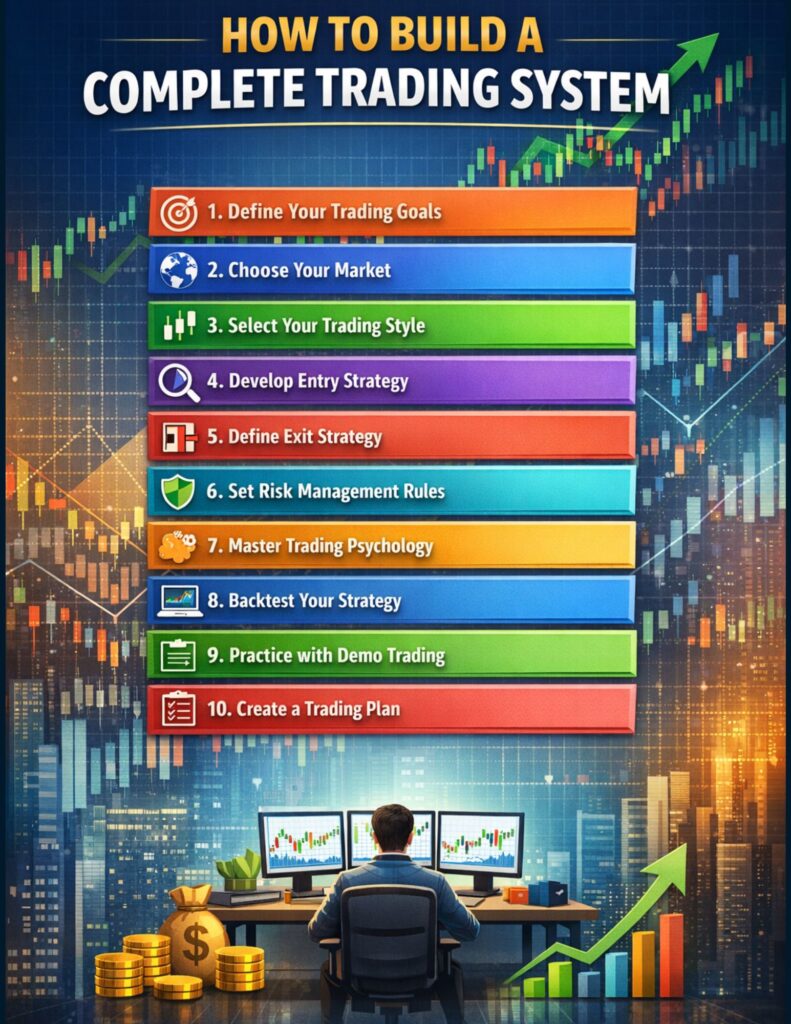
Step 6: Risk Management Guidelines
Every discussion on how to construct a Complete Trading System would not be considered complete without discussing risk management guidelines.
Guidelines include:
- Do not place risk on more than 1–2% of capital on each trade
- Avoid over leveraging
- Proper position sizing
Professional traders prioritize capital protection over profits.
Step 7: Trading Psychology & Discipline
Even the best system fails without discipline. That is precisely why psychology is one of the key elements of How to Build a Complete Trading System.
Typical emotional problems:
- Fearing losses
- Desiring more profits
- Overtrading
- Revenge trading
The solution is obvious: just stick to your system regardless of anything.
Step 8: Backtesting Your Strategy
Backtesting is a critical step in How to Build a Complete Trading System.
Testing is conducting back-tests of your strategy using historical data to determine how your strategy would have fared.
Advantages:
- Provides confidence
- Determines weaknesses
- Increases accuracy
TradingView offers an easy way for you to conduct such tests.
Step 9: Practice Using Demo Trading
Before engaging in actual trading, practice becomes crucial in the process of learning how to build a Complete Trading System.
Some of the benefits that can be derived from demo trading include:
- Putting your system to the test in live situations
- Gaining confidence
Do not engage in real trading unless you are making profits in demo.
Step 10: Create a Trading Plan
A written plan is what separates amateurs from professionals in How to Build a Complete Trading System.
Your plan should include:
- Entry rules
- Exit rules
- Risk management strategy
- Daily trading routine
Think of it as your trading rulebook.
Step 11: Keep a Trading Journal
Journaling is frequently overlooked but it is a strong technique within the context of How to Build a Complete Trading System.
Write down:
- Entry and exit points
- Gain and Loss
- Rationale for trade
- Emotional status
Doing so will help you analyse your trading and become better at it.
Common Mistakes to Avoid
While learning how to build a Complete Trading System avoid these mistakes:
- Changing strategies frequently
- Ignoring stop-loss
- Following the tips blindly
- Overtrading
- Consistency is the key to success.
Example of a Simple Trading System
Let’s simplify how to build a Complete Trading System with an example:
- Market: Stocks
- Style: Swing Trading
- Entry: Price above 50-day moving average + breakout
- Stop-loss: Below recent support
- Target: 1:2 risk-reward
This simple system can already bring structure to your trading.

Conclusion
In conclusion, I believe that by now you have understood how to construct a Complete Trading System. Trading is not a matter of luck; rather, it is one of discipline, strategy, and consistency.
No system guarantees that all your trades will win, but it definitely assures profits.
Start simple and gradually improve your system.
Final Tip
If you are serious about mastering How to Build a Complete Trading System, don’t rely only on theory. Learn with practical exposure, live market sessions, and expert guidance.
Because in trading execution matters more than knowledge.
FAQS
1. What Is the Trading System In the Stock Market?
A trading system can be explained as a set of predefined conditions designed to help traders make decisions about entering the market, exiting and managing trades in order to generate consistent results.
2. Why Should You Study the Creation of How to Build a Complete Trading System?
Knowing how to build your own Complete Trading System will make you trade better and reduce your dependency on emotions while doing so.
3. Can Beginners Learn How to Build a Complete Trading System?
Yes, beginners can know how to create a Complete Trading System for themselves.
4. How Much Money do You Need To Have To Make A Trading System?
You can work with whatever amount of capital you have, starting with as little as ₹5,000 to ₹10,000 since the primary concern would be strategy.
5. What is the best trading system that you can use?
It is impossible to tell which strategy is the best. Every person ideal trading strategy varies based on personal preferences.
6. How Long Will It Take Me To Make a Complete Trading System?
Creating a Complete Trading System can take weeks or even months.