
For those who have recently entered the stock market, they might have heard stock traders referring to call options and put options. These terminologies can be quite confusing at the start, but after gaining some basic knowledge about them, things will get easier for you. This article on how to understand call and put options trading will help you know all the basics about these options in simple terms so that you can begin options trading with ease.
Options trading is quite popular among traders because of the low cost involved compared to buying stocks. But there is a certain amount of risk involved in it. So, to avoid losses, one needs to gain the knowledge about how to understand call and put options trading.
What Is Options Trading?
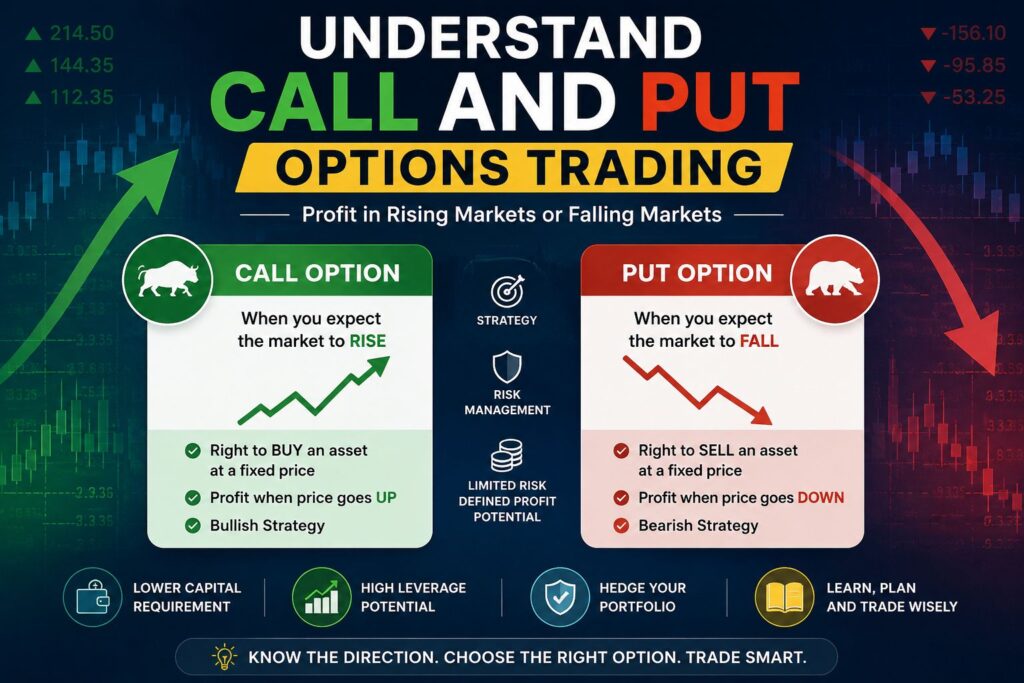
Options trading refers to derivative trading in which there are options contracts whose values depend on other assets, for example, stocks or indices like Nifty and Bank Nifty. In options trading, one does not buy the asset directly rather, one buys the option contract on the asset.
There are two major kinds of options: call options and put options. Understanding both kinds is the basic principle of options trading. Understand Call and Put Options Trading
What Is a Call Option?
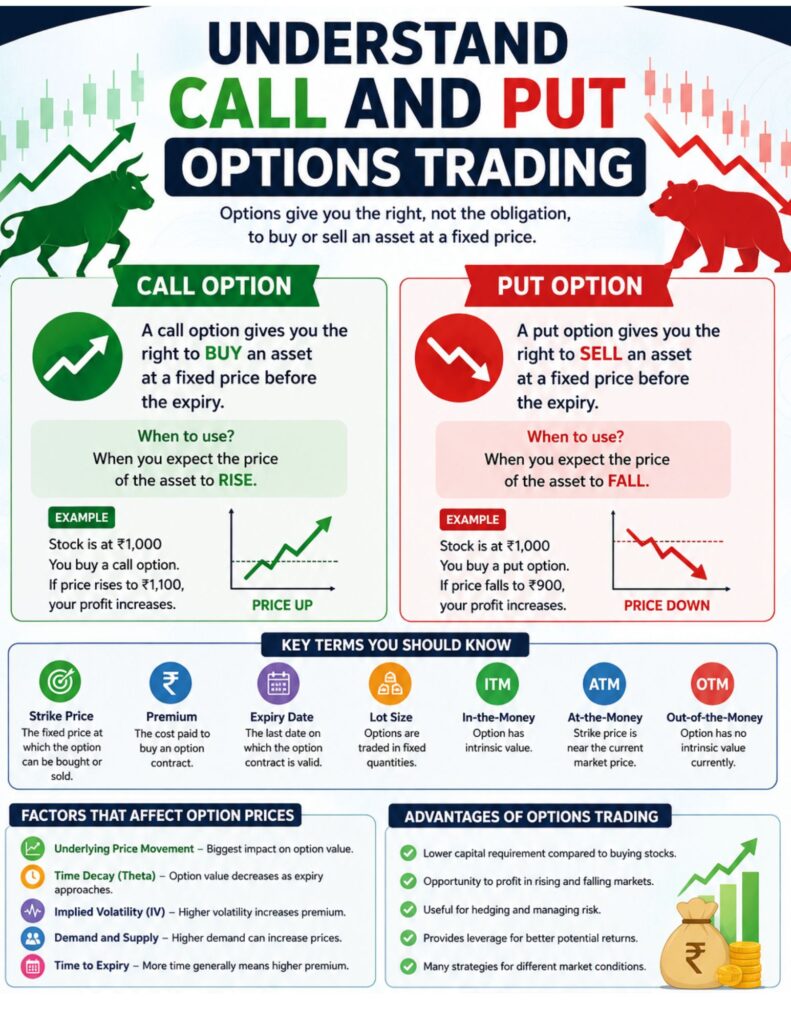
A call option enables the holder of the option contract to have the right, but not the obligation, to purchase an underlying asset at a pre-determined price called the strike price before the expiration of the option.
Generally, the investors like to trade call options when they expect the market price to increase. The reason for this is that when the price of the share or index increases, the call option value increases, thereby creating profit.
For example, if the market price of the share is ₹1,000 and it is expected to increase to ₹1,100, then the investor can make a profit out of this situation through trading in call options without buying the shares. This simple concept is an important part of understand call and put options trading.
What is a Put Option?
The put option gives the holder the right, but no obligation, to sell the underlying security at a predetermined price before the expiry date of the contract.
The traders purchase put options in anticipation that there will be a fall in the market. The lower the stock price goes, the higher the value of put options gets, and this way the trader can make profits.
For example, if the price of a stock is ₹2,000 and you anticipate a fall in the stock to ₹1,900, then putting a put option on the stock can prove to be beneficial for you. Learning how put options work is another essential step in How to understand call and put options trading.
Key Terms That Are Essential for Your Understanding
To trade options, there are some basic key terms that you need to know.
- Strike Price is the price at which the option will be used.
- The Premium is the cost of buying the option deal.
- Expiration Date is the date after which an option expires.
- Lot Size refers to the number of shares of units contained in an option contract.
You also need to be aware of the meaning of ITM (In-The-Money), ATM (At-The-Money), and OTM (Out-of-the-Money), because these terms indicate the relationship between the strike price and market price. These terms help beginners to understand call and put options trading. easily.
How do Traders Earn Money?
Trading in options is quite easy. The goal of the options traders is to buy options with low premiums and then sell them at high premiums.
If you purchase a call option and the market moves up, its premium will rise. Likewise, in case you have purchased a put option and the market falls, its premium will rise too.
For instance, when you purchase an option at ₹40 but eventually sell it at ₹70, the profit from this trade will be ₹30 before commission and other taxes. Knowing how to do this is one way of understand call and put options trading..
Factors that Influence the Pricing of Options
Several factor determine the price of an option.
The most important factor affecting the price of an option is the change in the underlying asset’s price or index. Time also influences the price of options, considering that their price decreases as the expiry date nears.
The importance of implied volatility is not just limited to this. Implied volatility usually has the effect of raising premiums since higher volatility increases the probability of large price changes. In addition to the demand for and supply of an option, the time until expiration also influences the cost of the option. understand call and put options trading.
Advantages and Disadvantages of Trading in Options
There are many advantages of trading in options. This includes the lesser amount of capital required compared to investing in shares, and options can be traded in both bullish and bearish market conditions.
There are also risks involved in options trading. The amount of premium paid may become worth nothing if the market does not work in your favour. You also need to consider time decay, which can devalue your options despite the stability of the market. understand call and put options trading.
Tips for Beginners
If you are new to options, you should not be taking risks with too much capital. Begin with paper trading and then demo trading to understand option trading.
Analyse the market trend and build up your technical skills and make sure to have a plan before starting trading. Use a stop-loss order and maintain a journal of your trades to help you build your skill set. never depend on rumours and emotions while deciding anything.
By following these habits, you can progressively develop skills to understand call and put options trading..
Conclusion
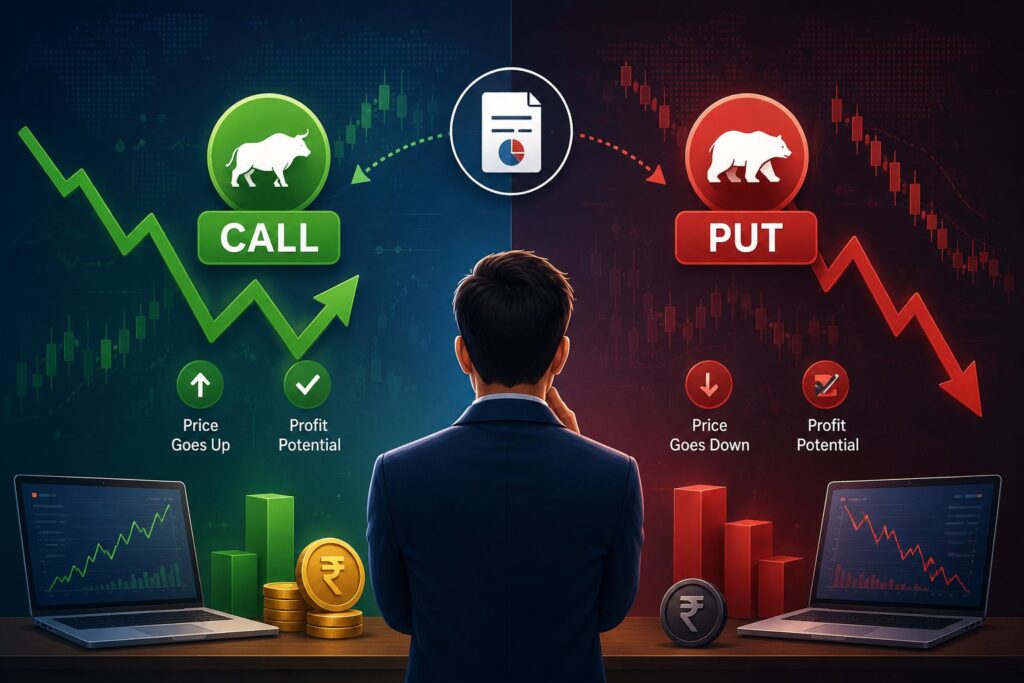
Understand call and put options trading is the basis of options trading. Traders normally employ call options if they believe prices will move upwards, while put call ratio is used for trading options are the choice of traders who believe prices will move downwards. Some of the key concepts in options trading include strike price, premium, expiration date, and time decay.
It should be noted that options trading has both risks and advantages. One must educate themselves first, practice consistently and focus on risk management rather than quick money-making. Learn how to trade calls and puts by resolution and constant studying.