
In stock market trading, there is one golden principle that reigns supreme Don’t think about profits, think about protection.
That is precisely where Trader Hedged Using Nifty Options comes in During highly volatile market conditions, every astute trader is aware that controlling risk is as vital as pursuing returns.
Let’s dive in and learn how a hedging trader with Nifty options can protect capital, maintain profit levels, and trade with confidence.

1. The Definition of Hedging
Hedging is a strategy of trading employed for offsetting the risk associated with price fluctuations in an asset.
It is similar to insuring your portfolio. You get your car insured against accidents, and you Trader Hedged Using Nifty Options.
One of the most practical and less costly mechanisms for Indian traders to hedge their market positions is via Nifty Options derivative contracts of the Nifty 50 index.
2. What Are Nifty Options?
Before knowing how a Trader Hedged Using Nifty Options, one should know what such instruments exactly are.
Nifty Options are derivative contracts of the Nifty 50 Index, which holds the top 50 companies listed on the NSE (National Stock Exchange).
Every Nifty option contract contains:
- Strike Price – The predetermined level at which you can sell or purchase the index.
- Premium – Amount of money paid to purchase the option.
- Expiry Date – The date when the option contract expires.
- Lot Size – Predefined amount per contract .
There are two categories of options:
- Call Option (CE): Offers the right to purchase the index.
- Put Option: the right to sell the index
When the market becomes uncertain, traders use these options to create a hedge against their portfolio or open positions.
3. Why Traders Use Nifty Options for Hedging
A Trader Hedged Using Nifty Options has a definite intention of hedging their portfolio against unpredictable movement while preserving the upside potential.
Why Nifty Options are a favourite hedging instrument:
✅ Low Cost: Options, as compared to futures, involve lower premiums.
✅ Flexibility: Traders can create bespoke strategies in line with the market view.
✅ Liquidity: Nifty options are highly liquid and provide easy entry and exit.
✅ Risk Limitation: Loss is beat at the premium paid.
Trader Hedged Using Nifty Options isn’t meant to prevent losses altogether it’s meant to manage them intelligently.
4. Popular Hedging Strategies Using Nifty Options
Let’s discuss the best practices employed by a Trader Hedged Using Nifty Options:
a. Protective Put Strategy
It’s one of the simplest yet powerful hedging strategies.
- The trader is long Nifty or Nifty futures.
- For hedging, the trader purchases a Put option at or very close to the prevailing market price.
Example:
Nifty is at 22,000.
You are long in Nifty futures.
To hedge, you purchase a 22,000 Put option for ₹120.
If Nifty falls to 21,500
- The futures position loses ₹500 points.
- The Put option gains nearly ₹400–₹450 points.
Your loss is minimised, that’s the power of hedging.
b. Covered Call Strategy
By traders already holding Nifty or index-heavy stocks and anticipating the market to move sideways.
- The trader writes a Call option against the holding.
- This creates income from the premium but reduces upside potential to a certain extent.
If the market does not move much up, the premium received works as a buffer.
c. Collar Strategy
A symmetrical hedge for traders seeking protection at low or no cost.
- Buy one Put (for protection).
- Sell one Call (to finance the cost of the Put).
- This strategy sets a range of profit and loss that is both capped and predictable.
It’s suitable for conservative investors handling portfolios of lakhs.
d. Bear Put Spread
Applied when anticipating a modest decline in Nifty.
- Buy higher strike Put and sell lower strike Put.
- Decreases the cost of the hedge but continues to offer protection against a downfall.
e. Bull Call Spread
Applied when anticipating a modest increase.
- Buy a lower strike Call and sell a higher strike Call.
- This caps both gains as well as losses while hedging exposure adequately.
5. Practical Example Trader Hedged Using Nifty Options
Let us learn this with an example:
- Nifty is at 22,000.
- The trader has long Nifty futures.
- To hedge, the trader buys 22,000 PE (Put Option) at ₹120.
If Nifty drops to 21,400, the futures lose ₹600 points.
However, the Put option adds approx. ₹500 points.
Net Result:
- Total loss = ₹100 points (cheap)
- Without hedge = ₹600 points loss (heavy loss)
This illustrates the way an Nifty options trader is able to save capital in periods of market fluctuation.
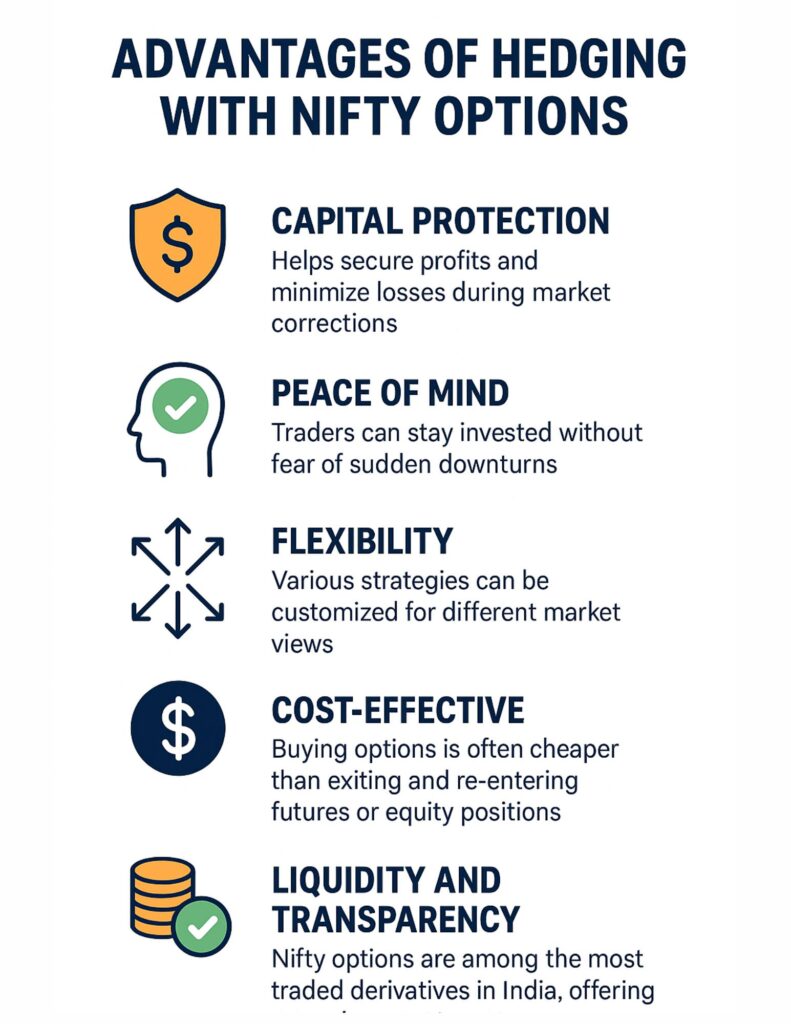
6. Advantages of Trader Hedged Using Nifty Options
Capital Protection:
- Helps to lock profits and limit losses at market
Peace of Mind:
- Investors are free to stay invested without apprehension of sharp falls.
Flexibility:
- Various strategies can be so moulded as per different opinions of the market.
Cost-Effective
- Buying options tends to be cheaper compared to rolling off and re-entry of futures or equity trades.
Liquidity and Transparency
- Nifty options are one of the most active trade derivatives and offer smooth execution.
7. Trader Hedged Using Nifty Options Limitations and Risks
Hedging may sound ideal, but there are some limitations that traders should be aware of:
Premium Cost:
- Each hedge incurs a cost the premium paid cuts down on overall profit.
Time Decay (Theta):
- Options lose value as time to expiry reduces, even if the market does not move.
Poor Selection of Strike:
- A miscalculated strike price can render the hedge useless.
Complex for Beginners:
- Needs knowledge of option Greeks such as Delta, Vega, and Theta to plan accordingly.
Which is why education and practice in the live market are important before putting these strategies to work.
8. Key Takeaways
A Trader Hedged Using Nifty Options guarantees protection against volatile swings in the market.
- It’s not a question of eliminating losses but of managing and minimizing them intelligently.
- Choosing the correct price, expiry, and with proper hedging.
- Always analyse volatility and use proper risk management tools

9. Conclusion
In today’s fast-moving market, ignoring risk is like walking blindfolded across a highway.
A trader hedged using Nifty options not only protects his capital but also gains the confidence to trade boldly.
The real difference between a professional and an amateur trader lies in risk control, not luck.
Nifty Options provide that cushion which every trader needs to survive and progress.
So if trading is seriously on your mind, learn the art of hedging, become an expert in option strategies, and lock your portfolio in time.