
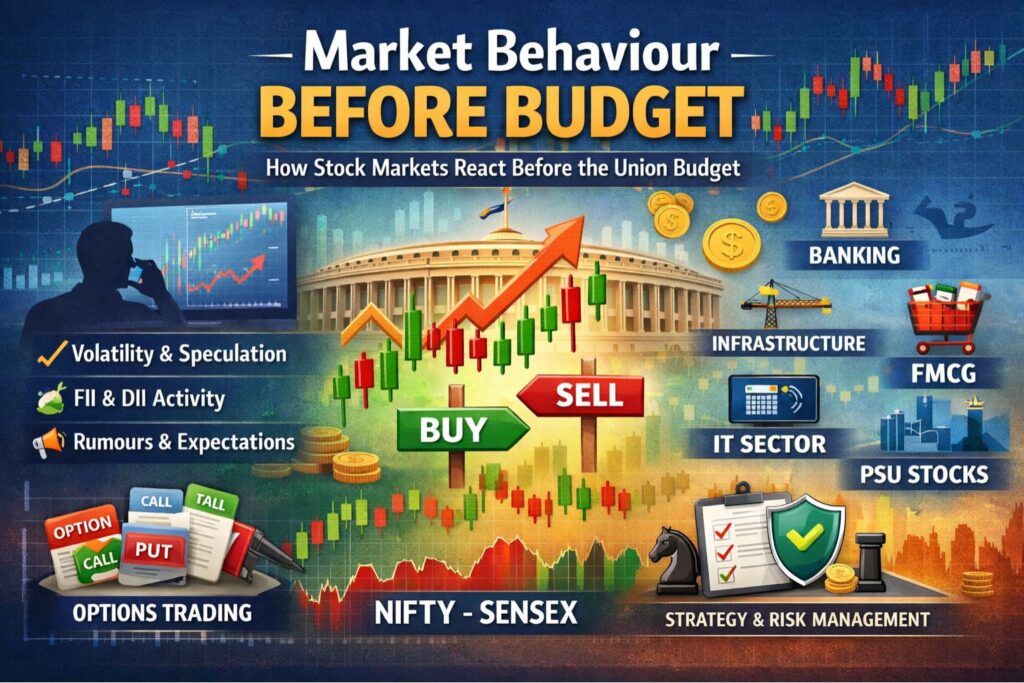
Every year, the Union Budget becomes one of the most anticipated events for the Indian stock market. Long before the Finance Minister stands up to present the Budget, the market starts reacting. Traders, investors, institutions, and even beginners closely watch price movements, sector rotation, and news flow. Market Behaviour Before Budget is essential for anyone who wants to trade or invest in the market during this critical phase.
In this blog, we will explore the analysis of how and why markets behave in a different manner before the Budget, what trends repeat themselves almost every year, and how you can prepare yourself to make unemotional decisions.
Why is the Union Budget important for the Stock Market?
The Union Budget is an important economic plan of the government for the next financial year. It includes taxation policies, infrastructure development, and sector allocation and reforms. All these directly or indirectly affect corporate profits, consumer demand and investor sentiment.
As a result, Market Behaviour Before Budget is often driven by expectations rather than realities. Markets begin to price in potential outcomes weeks before resulting in volatility and uncertainty.
Rising Volatility: A Key Feature Before the Budget
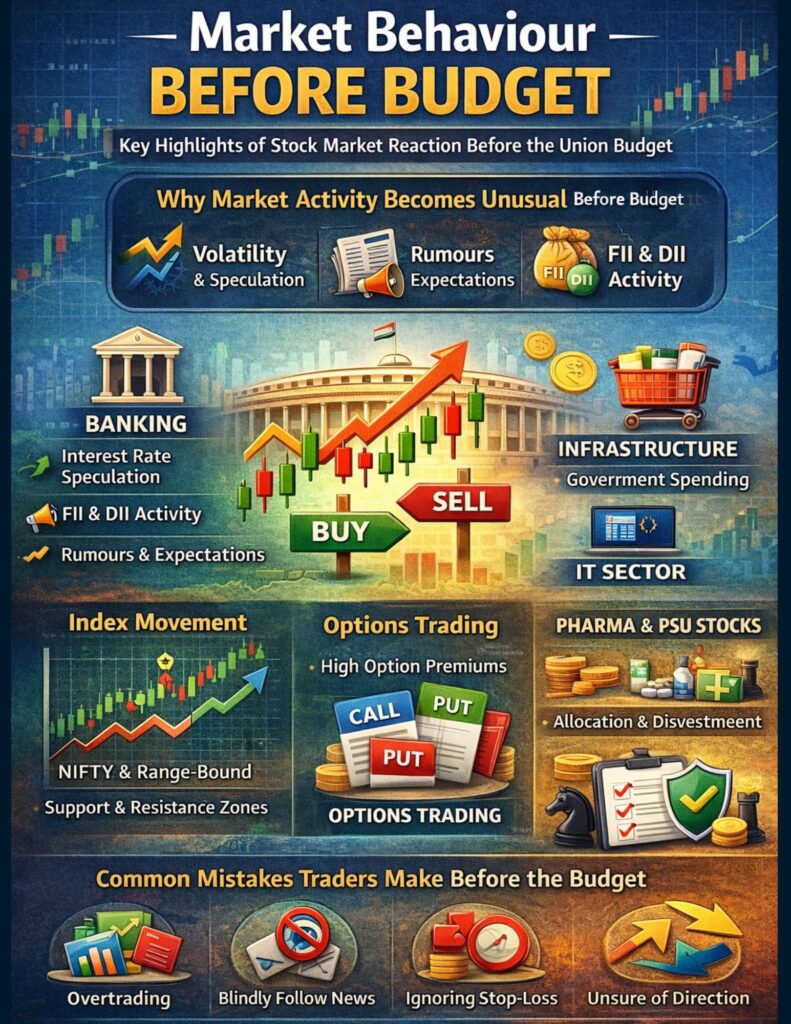
One of the most striking features of the pre-budget period is the rise in volatility. Index movements become sharp and unpredictable. This happens because:
- Traders try to position themselves early.
- Institutions rebalance portfolios
- News channels constantly speculate on the budget outcomes.
- Fear and greed work together.
This volatility is one of the essential characteristics of Market Behaviour Before Budget, and new entrants in the market tend to find this phase confusing.
The Role of Expectations and Speculation
Markets are always forward-looking. They do not act on announcements; they act on expectations. If the market expects that a certain sector will benefit from the Budget, prices can move upwards even before the announcement.
This is why Market Behaviour Before Budget is driven more by assumptions than facts. Sometimes, even a good Budget fails to push markets higher because the positive outcome was already priced in.
“Buy on Rumours, Sell on News” Explained
A famous market saying becomes very relevant here. During the pre-budget phase, prices move based on rumours and expectations. Once the Budget is out, profit booking starts happening.
This is very much linked to Market Behaviour Before Budget, where smart money enters the market early and exits as soon as there is clarity.
Sector-Wise Trends Before the Budget
Sectors perform differently in the pre-Budget phase based on policy expectations.
- Banking and Financial Sector
Banks are likely to remain volatile based on expectations of interest rate changes and financial sector reforms.
- Infrastructure and Capital Goods
These stocks are expected to see interest on account of hopes of increased government spending.
- FMCG
Hopes related to tax relief, inflation control, and rural demand affect FMCG stocks.
- IT Sector
IT stocks are more dependent on global cues but are also influenced by tax and policy hopes.
- PSU Stocks
Disinvestment plans and reforms often make PSU stocks active in the lead-up to the Budget.
This sector rotation is a clear reflection of Market Behaviour Before Budget and offers both opportunities and traps.
FII and DII Activity Before the Budget
Foreign Institutional Investors (FIIs) and Domestic Institutional Investors (DIIs) play a massive role during this period. FIIs may cut their exposure if there is uncertainty in the global market, whereas DIIs are known to bring stability.
Monitoring institutional investments can be helpful in understanding Market Behaviour Before Budget, as retail investors tend to follow the lead of larger market players.
Index Movement Patterns: Nifty and Sensex
In the pre-Budget period, indices tend to remain in a range with sharp movements upwards or downwards. Support and resistance levels is more important than trends.
Many times, markets consolidate just before the Budget, showing hesitation. This sideways movement is another common trait of Market Behaviour Before Budget.
Derivatives Market and Option Activity
The derivatives segment becomes highly active before the Budget. Option premiums rise due to increased implied volatility. Traders expect big moves but are unsure of direction.
Professional traders focus more on volatility-based strategies rather than directional bets during Market Behaviour Before Budget.
Trading vs Investing What Should You Do?
Short-term traders and long-term investors must approach this phase differently.
Traders are concerned with technical analysis, volatility, and risk management.
Investors avoid significant buying or selling and wait for clarity.
It is critical to understand this distinction to survive Market Behaviour Before Budget without incurring unnecessary losses.
Common Mistakes Traders Make Before the Budget
Many traders lose money not because the market is difficult, but because they act emotionally. Common mistakes include:
- Overtrading due to excitement
- Blindly following social media tips.
- Ignoring stop-loss
- Expecting guaranteed moves
Avoiding these errors is key to handling Market Behaviour Before Budget professionally.
How Smart Traders Prepare in Advance
Experienced traders do not try to predict the Budget. Instead they prepare for all scenarios. They reduce position size, protect capital and wait for confirmation.
This disciplined approach separates amateurs from professionals during Market Behaviour Before Budget.
Historical Patterns: Lessons from the Past
History shows that markets do not behave the same way every year before the Budget. Sometimes they rally, sometimes they fall, and sometimes they move sideways.
The only consistent truth is uncertainty. Studying past data helps in understanding Market Behaviour Before Budget, but blind assumptions should always be avoided.
Psychological Impact on Retail Traders
The pre-budget time creates pressure. Continuous news flow and expert opinions confuse retail traders. Emotional trades rise during this period. Emotional trades rise during this period.
Understanding this psychological element is an often-underestimated but crucial element of Market Behaviour Before Budget.
Risk Management Is More Important Than Profit
The pre-Budget period is the time when the preservation of capital becomes more important than making profits. One wrong trade can wipe out the profits of weeks.
Smart traders understand Market Behaviour Before Budget and do not stress aggression over survival.
Final Thoughts: Opportunity with Discipline
The pre-budget period is full of opportunities, but it is also a time of risk. The markets reward preparation, patience, and discipline, not predictions.
Market Behaviour Before Budget is a concept that, if understood, will help traders and investors avoid emotional pitfalls and prepare accordingly for pre-budget as well as post-budget market actions.
Rather than trying to forecast what the Finance Minister will say, listen to what the market is trying to tell you. Preparation always precedes prediction in the stock market.