
The stock market gives you multiple ways to earn money, but the real game starts when you choose the right strategy. Most newbies are often confused by the terms Swing Trading vs Intraday Trading. Actually, this is quite a valid reason for being confused, since both swing trading and intraday trading can yield good profits.
It’s not only about timing but also mindset and lifestyle. In the blog about Swing Trading vs Intraday Trading, you’ll learn all about both these strategies, along with their pros and cons and which strategy really fits you.
Definition of Swing Trading
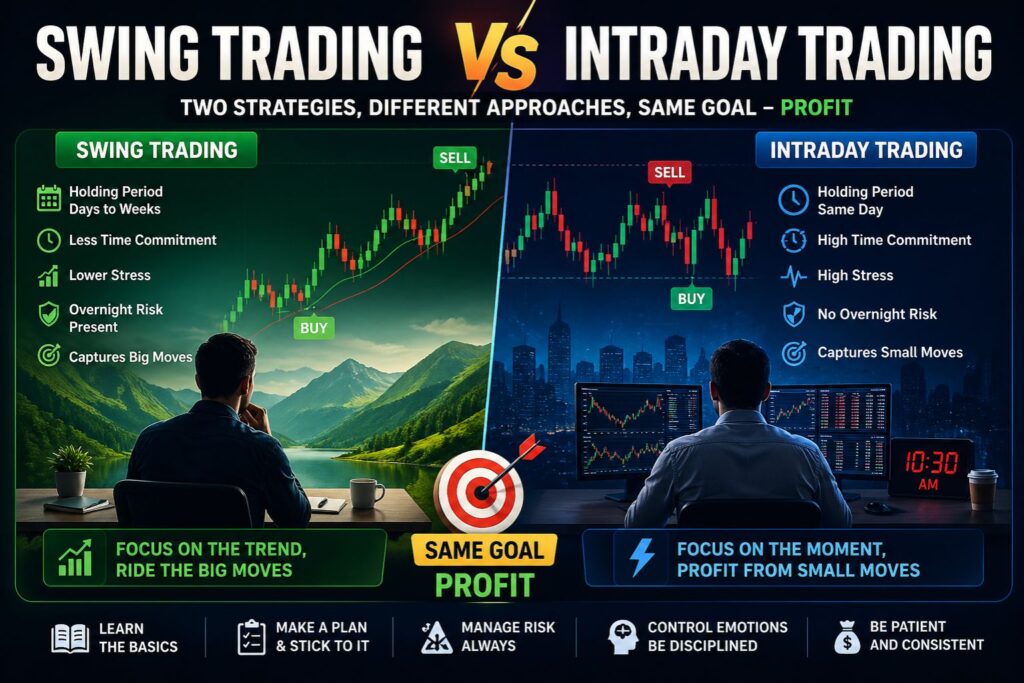
It is the technique where a trader keeps their shares for several days or even weeks. The concept here is simple. You have to spot an emerging trend in advance, enter into the trade at the right point and exit after a favourable move in price.
The Swing Trading vs Intraday Trading is explained in detail here. Unlike intraday trading, swing trading is flexible, allowing the trader to avoid constantly keeping eyes glued to the screen.
A swing trader will use technical indicators such as support and resistance, moving average and Relative Strength Index. News and fundamental analysis is also considered.
Example:
Imagine a stock trading at ₹200 that shows a breakout pattern. A swing trader buys it and holds for 5–7 days. If the stock reaches ₹230 they book a profit of ₹30 per share.
What is Intraday Trading?
Intraday trading refers to stock trading where buying and selling take place on the same day without taking any positions beyond market hours.
In comparing Swing Trading to Intraday Trading, intraday trading is quick, aggressive, and needs high concentration.
The intraday trader makes use of very tiny price changes and trades repeatedly within a day. It uses the real-time volume and charts.
Example:
An investor purchases the stock for ₹500 at 10:00 AM and then sells it for ₹505 by 11:30 AM. Profit is minimal, but transactions are rapid.
Key Differences Between Swing Trading and Intraday Trading
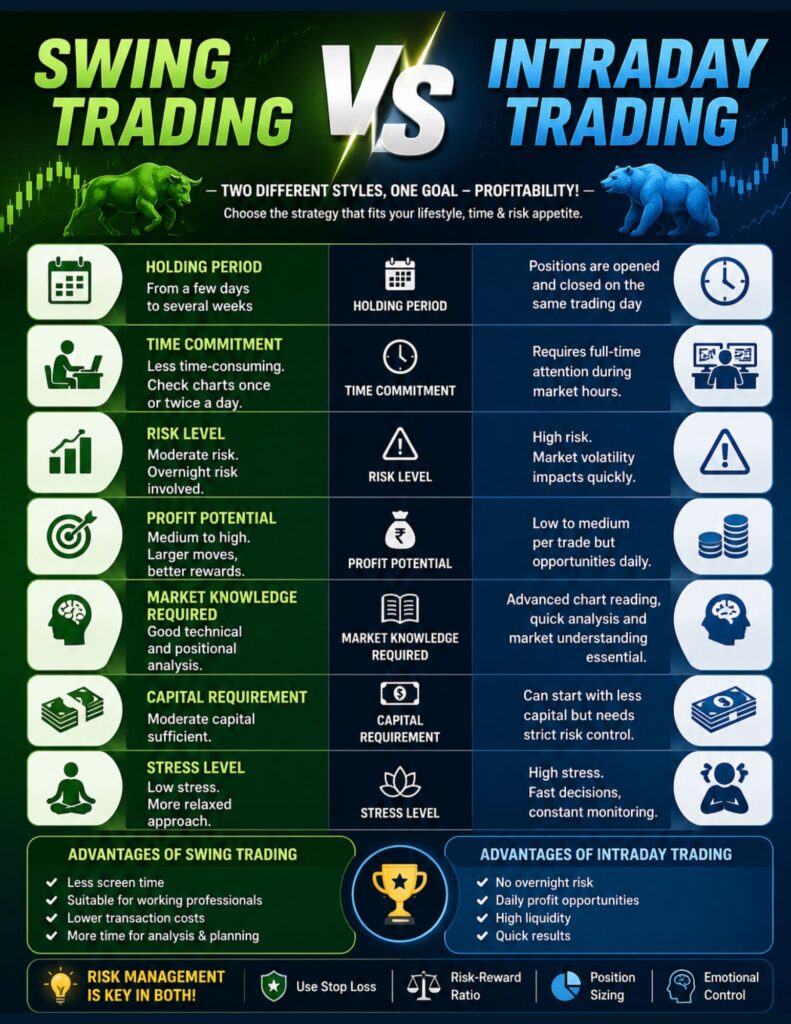
The critical distinction between Swing Trading vs Intraday Trading lies in the differences in timing risk and investment strategies.
In Swing Trading, investors have the freedom to maintain their investments for several days or even weeks. However, in Intraday Trading, one is obligated to exit the trade within the same day.
Risk Management is also Different in Swing Trading and Intraday Trading. Swing traders incur risks at night because of global events while intraday traders do not experience that risk but are exposed to volatile prices throughout the day.
Another major difference is stress level. Swing trading is comparatively calm, while intraday trading can be mentally exhausting because decisions need to be made within seconds.
Advantages of Swing Trading
In the debate of Swing Trading vs Intraday Trading, swing trading offers several practical advantages.
First, it is less time-consuming. You don’t need to track the market every minute. This makes it perfect for students, jobholders, or business owners.
Second it gives you better decision-making time. You can analyse charts calmly and avoid impulsive trades.
Third, the stress level is lower. Since you are not forced to make quick decisions, you can trade more logically.
Lastly, brokerage costs are usually lower because you are trading less frequently compared to intraday trading.
Advantages of Intraday Trading
Now let’s look at intraday trading in Swing Trading vs Intraday Trading comparison
One of the biggest advantages is that there is no overnight risk. You close all positions before the market ends, so global news or sudden events won’t affect your trades.
Second, intraday trading gives daily earning opportunities. You don’t have to wait for days or weeks to make money.
Third, liquidity is high. You can easily enter and exit trades without much difficulty.
Lastly, results are fast. You know your profit or loss within hours.
Disadvantages of Swing Trading
Even though swing trading looks easier in Swing Trading vs Intraday Trading, it has its own drawbacks.
The biggest issue is overnight risk. News, global markets, or unexpected events can affect your trade.
Second, profits are slower. You need patience to wait for the trade to move.
Third, sometimes markets move sideways, and you might not get good opportunities for days.
Disadvantages of Intraday Trading
Intraday trading is not as easy as it looks in the Swing Trading vs Intraday Trading comparison.
It requires full-time attention. You cannot treat it as a side activity.
The stress level is very high because you are constantly watching price movements and making quick decisions.
Another problem is overtrading. Many traders take too many trades and lose money due to a lack of discipline.
Also, brokerage and charges can eat a big part of your profits if not managed properly.
Risk Management in Swing Trading vs Intraday Trading
No matter which side you choose in Swing Trading vs Intraday Trading, risk management is the real key to survival.
Always use a stop-loss. This protects your capital from big losses.
Maintain a proper risk-reward ratio. you should risk ₹1 to make ₹2 or more.
Avoid emotional trading. Fear and greed are the biggest enemies in trading.
Never put all your money in one trade. Diversification and position sizing are very important.
Tools and Indicators Employed
When it comes to Swing Trading vs Intraday Trading, there are slight differences in the tools employed.
Swing trading involves the use of indicators such as moving averages, RSI and trend lines for identifying trends.
Intraday trading, on the other hand, uses faster indicators such as VWAP, MACD, and volume for identifying fast movements.
Which Is More Suitable for You?
Choosing between Swing Trading and Intraday Trading, the most important thing to figure out is – which one do you go for?
In case you are working or running a business, and hence cannot afford to trade full-time, then you can choose swing trading as a more suitable strategy.
If you can sit in front of your chart screens for long periods, withstand pressure, and take fast decisions, then intraday trading might be something you go for.

Common Mistakes to Avoid
While learning Swing Trading vs Intraday Trading, traders often make common mistakes.
- They trade without a proper plan.
- They ignore stop-loss.
- They follow random tips from social media.
- They let emotions control their decisions.
- They overtrade in the hope of quick money.
Avoiding these mistakes can save you from major losses.
Conclusion
In conclusion, Swing Trading vs. Intraday Trading is more of a choice based on your personality and risk appetite rather than what is right and wrong.
Swing trading offers you flexibility and less stress, whereas intraday trading offers you faster results
However, there is one common denominator that, without adequate knowledge and discipline, both of them may end up being losing strategies.
But if you really want to make money in the stock market, then education, experience, and mentoring are key.