The past few years have witnessed an unprecedented increase in the number of investors in the Indian stock market, with novices taking a particular liking to investing. Perhaps one of the major factors responsible for the growth has been the increasing popularity of “zero brokerage” applications such as Zerodha, Upstox, and Angel One.
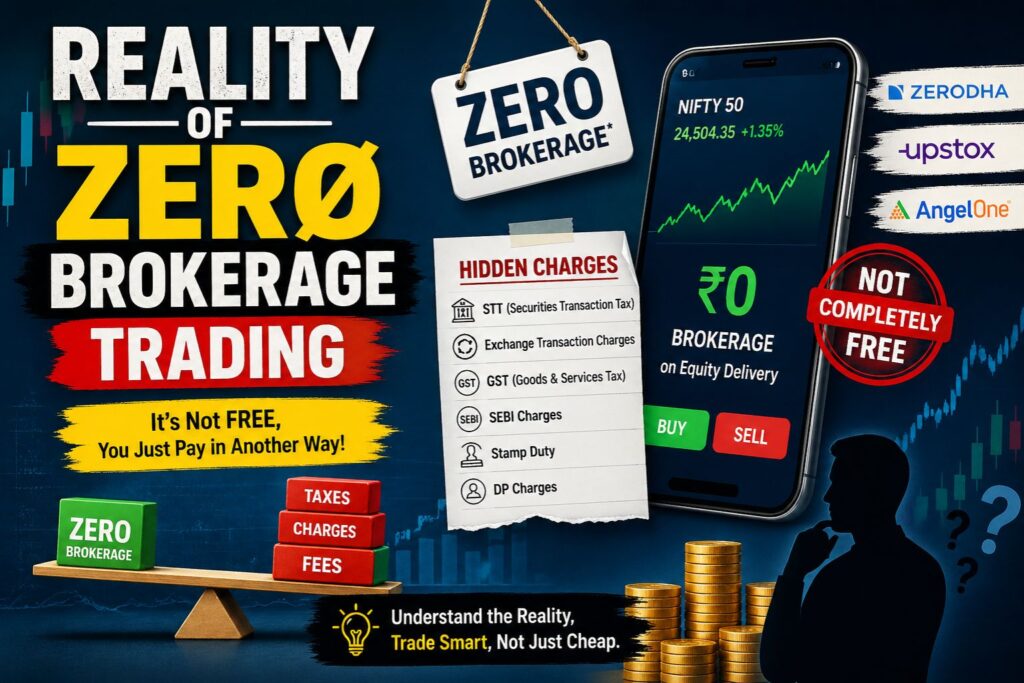
But is trading really free?
This is where the Reality of Zero Brokerage Trading comes into play. Although the theory looks appealing, the practical cost structure is much more complicated than most novices realise. This blog post aims to unveil the Reality of Zero Brokerage Trading, demystify the hidden costs involved, and guide you in determining if it is a wise choice or merely good marketing.
What Is Zero Brokerage?
To fully understand the Reality of Zero Brokerage Trading, it is essential first to understand what brokerage is.
When platforms advertise “zero brokerage,” it usually applies only to equity delivery trades. This means if you buy shares and hold them for the long term, you won’t be charged brokerage fees.
However for:
- Intraday trading
- Futures & Options (F&O)
- There are still fixed charges per order.
So, the Reality of Zero Brokerage Trading is that it is not entirely free; it is selectively free.
Charges Hidden from You
Beginners often make the mistake of guessing that no brokerage equals no costs.
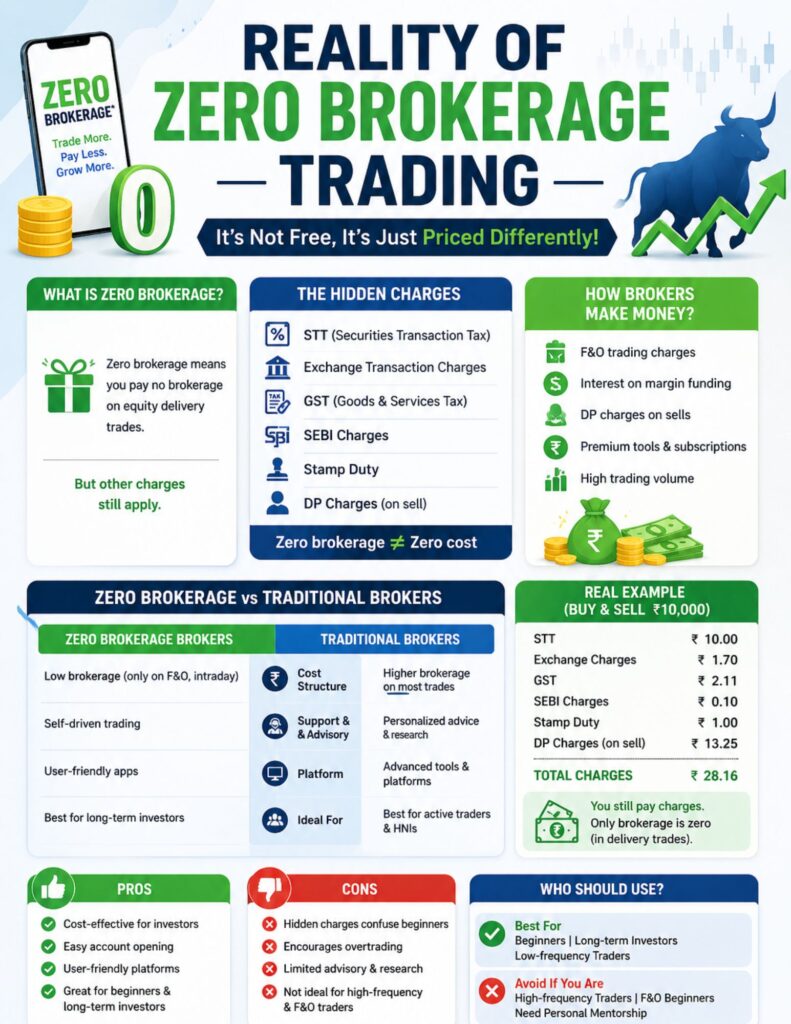
The reality of Zero Brokerage Trading is that some charges cannot be avoided:
1. STT (Securities Transaction Tax)
The Securities Transaction Tax is charged by the government on each transaction.
2. Exchange Transaction Charges
Fees are charged by exchanges like the National Stock Exchange of India and the Bombay Stock Exchange.
3. GST (Goods and Services Tax)
Applied to brokerage and other charges.
4. SEBI Charges
Regulatory fees required by the Securities and Exchange Board of India.
5. Stamp Duty
The state government charges for buying shares.
6. DP Charges
Incurred once you sell stocks from your Demat account.
These charges are inevitable, and they definitely prove the Reality of Zero Brokerage Trading, as there will always be something to pay.
How Brokers Make Money
If brokers don’t charge any brokerage, then how do they earn money?
This is an important aspect while learning about the Reality of Zero Brokerage Trading.
1. F&O Charges
Even zero brokerage platforms charge per order in derivatives trading.
2. Margin Funding Interest
If you trade with borrowed money, brokers charge interest.
3. DP Charges
Applied when you sell delivery shares.
4. Premium Features
Advanced charts APIs and tools often come at a cost.
5. High Trading Volume
More users = more trades = more overall revenue.
The Reality of Zero Brokerage Trading is that brokers earn indirectly, not that they earn nothing.
The Psychology Behind Zero Brokerage
The phrase “zero brokerage” is powerful. It attracts beginners instantly. But the Reality of Zero Brokerage Trading is deeply connected to trader psychology.
When people believe trading is free:
- They tend to trade more frequently.
- They take unnecessary trades.
- They ignore risk management.
This leads to overtrading which often results in losses far greater than any brokerage fee saved.
So, the Reality of Zero Brokerage Trading is not just about money, it’s about behaviour.
Zero Brokerage vs Traditional Brokers
Let’s compare zero brokerage platforms with traditional brokers like ICICI Securities and HDFC Securities.
- Zero Brokerage Brokers
- Lower upfront costs
- Simple apps
- No advisory support
- Traditional Brokers
- Higher brokerage
- Research and advisory
- Relationship managers
The Reality of Zero Brokerage Trading is that you save on cost but lose personalised guidance.
Advantages of Zero Brokerage Trading
Despite its limitations, there are real benefits:
1. Cost Saving for Investors
Long-term investors benefit the most.
2. Easy Access Quick
Account opening with digital.
3. Beginner-Friendly Platforms
Simple interfaces make trading easy.
Even here, the Reality of Zero Brokerage Trading remains cost is reduced, not eliminated.
Disadvantages You Should Know
1. Hidden Charges Confusion
Many users do not understand the full cost structure.
2. No Expert Guidance
You are mostly on your own.
3. Encourages Overtrading
Free trading mindset leads to losses
4. Limited Research Tools
Basic plans often lack depth.
These downsides clearly reflect the Reality of Zero Brokerage Trading; it’s not as perfect as it looks.
Who Should Be Using Zero Brokerage Platforms?
The Reality of Zero Brokerage Trading would be beneficial for:
- Newbies starting with a small capital
- Investors
- Low-frequency traders
Who Shouldn’t Be Using Zero Brokerage Trading Platforms?
Zero Brokerage Trading Platforms might not be ideal for:
- F&O newbies
- High-frequency traders
- Those requiring mentorship
Know the Reality of Zero Brokerage Trading to know whether it suits your trading style.
Example of Fees and Taxes
If you purchase equity worth ₹10,000 and then dispose of it later,
even without any broker fees:
- STT will apply
- GST will apply
- Exchange fees will apply
- DP fees will apply
The total fee structure might amount to ₹20–₹50 and above, depending on the nature of the transaction.
This case study demonstrates the Reality of zero brokerage trading. Zero brokerage doesn’t mean zero cost.
Myths Surrounding Zero Brokerage
Myth #1: Trading Is Free
Reality: It’s only free from brokerages in certain cases.
Myth #2: There Are No Hidden Fees
Reality: All fees are stated but overlooked by most users.
Myth #3: Best for All Traders
Reality: Not necessarily.
The myths against reality highlight the Truth of Zero Brokerage Trading.
Tips for Saving Money while Trading
For handling the Truth of Zero Brokerage Trading, consider these tips:
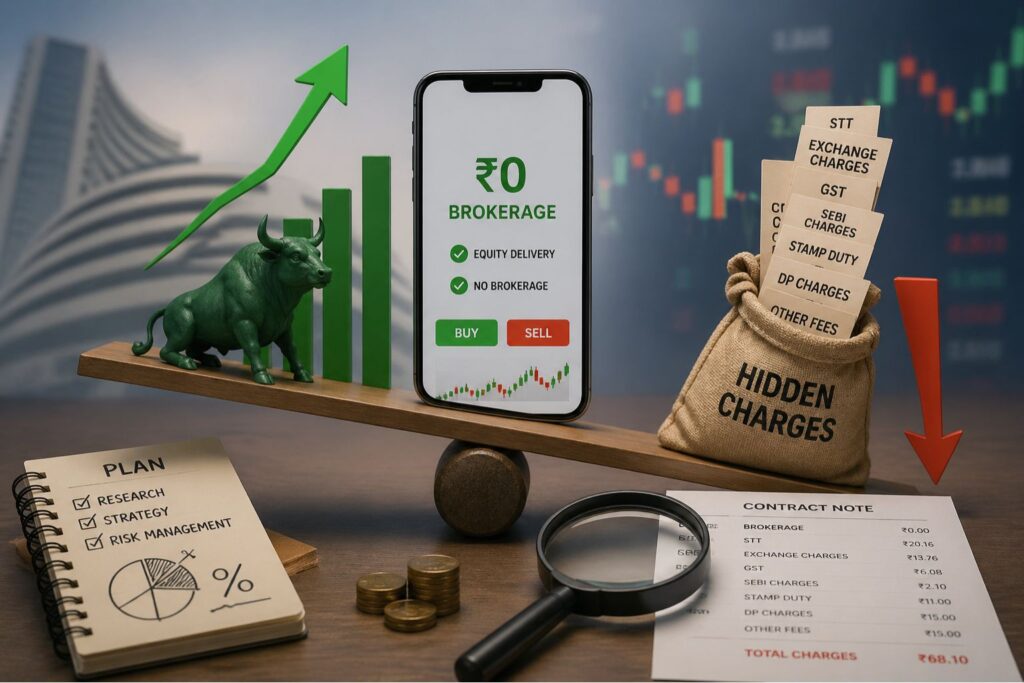
- Review the contract notes.
- Know your charges before you trade.
- Do not overtrade.
- It’s about strategy, not money
Conclusion
The Reality of Zero Brokerage Trading is simple nothing in the stock market is truly free. While zero brokerage platforms have made trading more accessible and affordable, they have also created mistakes among beginners.
Yes, you save on brokerage in certain segments. But you still pay taxes, fees, and sometimes even hidden costs. More importantly, the biggest risk is not the charges, it’s the behaviour that “free trading” encourages.
If you truly want to succeed in the market, focus less on saving brokerage and more on learning strategy, risk management, and discipline.
Because in the end, the real Reality of Zero Brokerage Trading is this:
It’s not about how much you save—it’s about how much you make and protect.