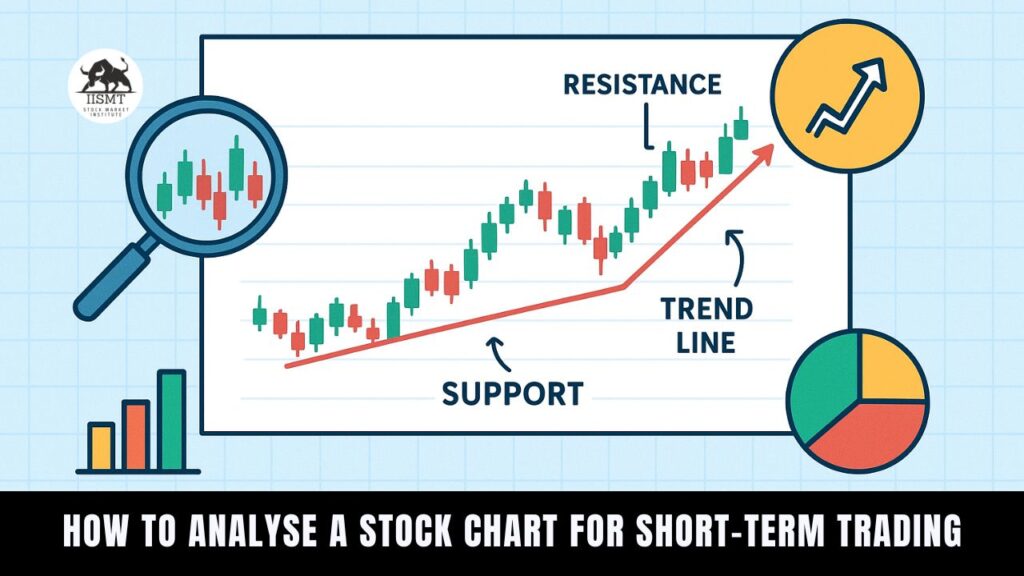
In the competitive world of trading, there is no room for hunches or luck; success is all about numbers, discipline, and tried-and-tested strategies. Backtesting Trading Strategies can be a tried-and-tested tool that helps experienced traders stand out from the rest. The first step before putting money in any trading strategy is testing its performance in the past with backtesting trading strategies.
This process not only builds confidence but also helps in refining and optimising trading systems.
In this blog, we will explore everything you need to know about Backtesting Trading Strategies, from basics to advanced techniques, so you can trade with confidence and consistency.
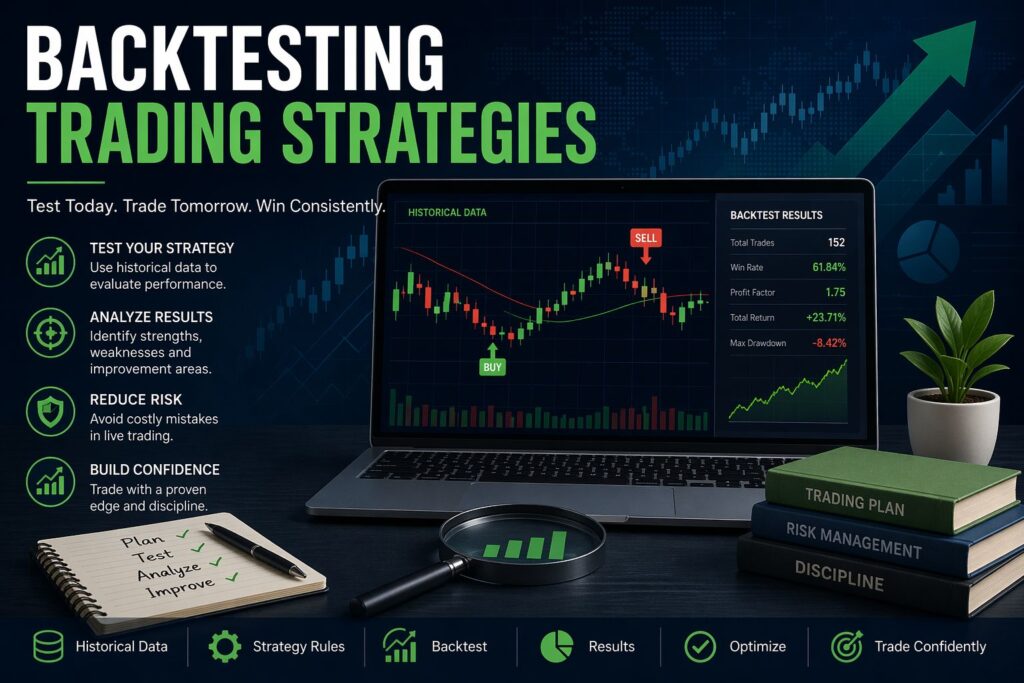
What is Backtesting Trading Strategies?
Backtesting Trading Strategies is the process of applying a trading strategy to historical market data to evaluate its performance.
In simple terms, it answers one important question:
If I had used this strategy in the past, would I have made money?
By analysing past price movements and applying predefined rules, traders can determine whether their strategy has an edge in the market.
Why Backtesting Trading Strategies is Important
Many traders jump into the market without testing their strategies, which often leads to losses. Here’s why it’s crucial:
- It helps eliminate emotional decision-making
- Builds trust in your trading system
- Identifies strengths and weaknesses
- Improves risk management
- Saves capital from unnecessary losses
Without proper Trading Strategies, trading becomes more like gambling than a calculated activity.
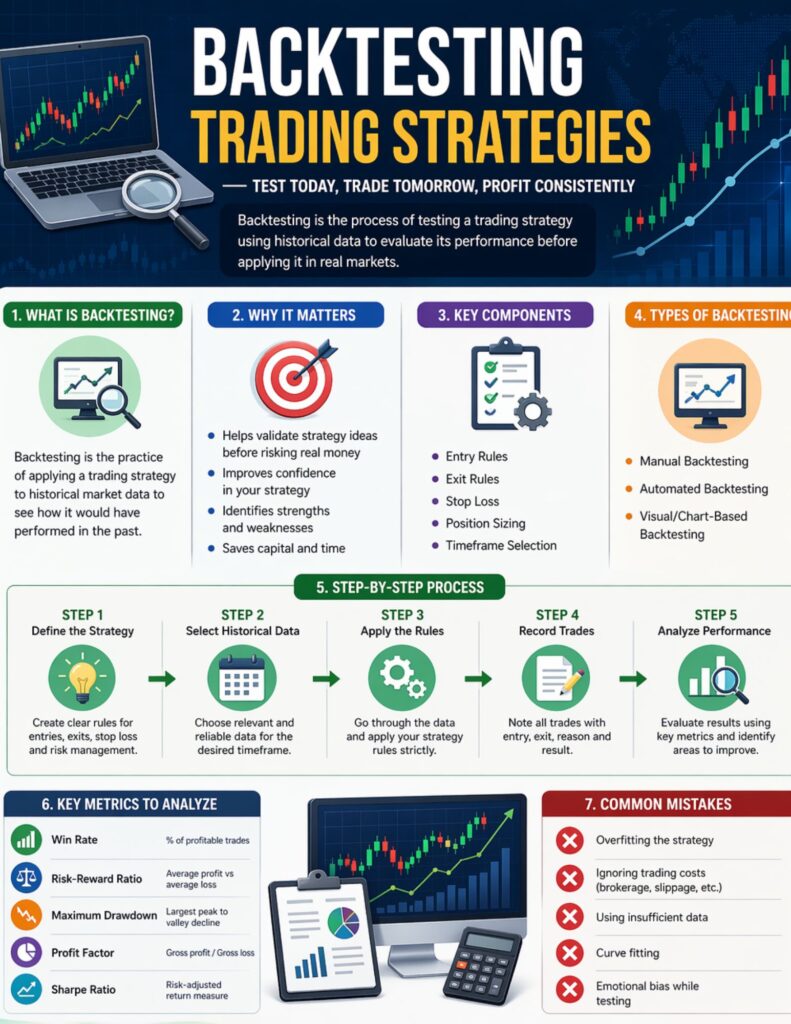
Key Components of Backtesting Trading
To perform effective Trading Strategies, you must clearly define:
1. Entry Rules
- When will you enter a trade?
- Example: Moving average crossover or breakout.
2. Exit Rules
- When will you close the trade?
- Example: Target hit or indicator reversal.
3. Stop Loss
- Defines how much risk you are willing to take per trade.
4. Position Sizing
- Determines how much capital you allocate per trade.
5. Timeframe
- Intraday, swing, or positional trading.
A strategy without clear rules cannot be properly tested using Backtesting Trading .
Types of Backtesting Trading Strategies
There are different ways traders perform Backtesting Trading Strategies:
Manual Backtesting
- Done by scrolling charts manually
- Best for beginners
- Helps understand price action deeply
Automated Backtesting
- Done using software or algorithms
- Faster and more accurate
- Suitable for advanced traders
Visual Backtesting
- Using chart replay features
- Combines manual and automated methods
Each method of Backtesting Trading has its own advantages depending on your skill level.
Step-by-Step Process of Backtesting Trading Strategies
Follow this structured approach for effective Backtesting Trading:
Step 1: Define Your Strategy
Clearly outline entry, exit, and risk rules.
Step 2: Choose Historical Data
Select reliable data covering different market conditions.
Step 3: Apply the Strategy
Execute trades based on your rules.
Step 4: Record Every Trade
Maintain a trading journal with:
- Entry & exit price
- Profit/loss
- Trade reason
Step 5: Analyse Results
- Evaluate performance metrics and identify improvements.
- Consistency is key when performing Backtesting Trading.
Important Metrics in Backtesting Trading
To measure the effectiveness of your strategy, track these:
- Win Rate – Percentage of profitable trades
- Risk-Reward Ratio – Profit vs loss per trade
- Maximum Drawdown – Largest loss streak
- Profit Factor – Total profit divided by total loss
- Sharpe Ratio – Risk-adjusted returns
These metrics help you understand whether your Backtesting Strategies are actually profitable or not.
Advantages of Backtesting Trading Strategies
Here’s why every trader should focus on Backtesting Trading Strategies:
- Provides data-driven insights
- Builds confidence before live trading
- Helps optimize strategies
- Reduces emotional trading mistakes
- Improves long-term consistency
Successful traders rely heavily on Trading Strategies to stay ahead in the market.
Limitations of Backtesting Trading Strategies
While powerful, Backtesting Trading Strategies also have limitations:
- Past performance does not guarantee future results
- Market conditions keep changing
- Data inaccuracies can affect results
- Over-optimisation can lead to false confidence
Understanding these limitations ensures realistic expectations from Trading Strategies.
Common Mistakes in Backtesting Trading
Avoid these mistakes while performing Backtesting Trading Strategies:
- Overfitting the strategy to past data
- Ignoring brokerage and slippage
- Using limited data samples
- Changing rules frequently
- Letting emotions influence decisions
- Proper discipline is essential in Backtesting Trading.
Backtesting vs Forward Testing
Many traders confuse these two:
- Backtesting Trading Strategies → Testing on past data
- Forward Testing → Testing in live market (demo or small capital)
Both are important. First, validate your system using Backtesting Trading, then test it in real-time before scaling.
Practical Example of Backtesting Trading Strategies
Let’s take a simple example:
Strategy: Moving Average Crossover
- Buy when the 50 EMA crosses above the 200 EMA
- Sell when it crosses below
- Stop loss: 2%
- Target: 4%
After applying Backtesting Trading on 2 years of data, suppose you find:
- Win rate: 55%
- Risk-reward: 1:2
- Consistent profitability
This shows the strategy has potential, but still needs further testing.
Tips for Effective Backtesting Trading Strategies
To get the best results from Backtesting Trading, follow these tips:
- Use at least 1–2 years of data
- Test in different market conditions (bull, bear, sideways)
- Stick strictly to the rules
- Include trading costs
- Focus on consistency, not perfection
Remember, the goal of Backtesting Trading is not to create a perfect strategy, but a profitable one.
Conclusion
In today’s competitive market, trading without testing is a costly mistake. Backtesting Trading Strategies provides a solid foundation for building profitable systems and minimising risks.
It transforms trading from emotional guessing into a structured, data-driven process. Whether you are a beginner or an experienced trader, mastering Backtesting Trading Strategies is essential for long-term success.
If you truly want to grow in the stock market, start testing your strategies before risking real money. That’s how professional traders build consistency and confidence.
FAQs
1. What is Backtesting Trading Strategies?
It is the process of testing a trading strategy using historical market data.
2. Is Backtesting Trading Strategies reliable?
Yes, but it should be combined with forward testing for better accuracy.
3. How much data is needed for backtesting?
At least 1–2 years of data is recommended.
4. Can beginners do Backtesting Trading Strategies?
Yes, manual backtesting is ideal for beginners.
5. Which tools are best for Backtesting Trading?
Platforms like TradingView, Excel, and MetaTrader are commonly used.
6. How accurate is Backtesting Trading?
Backtesting Trading can be highly useful, but it is not 100% accurate because market conditions change over time. It should always be combined with forward testing.
7. What is the best timeframe for Backtesting Trading?
The best timeframe depends on your trading style. Intraday traders may use 1–15 minute charts, while swing traders prefer daily or weekly charts for Backtesting Trading.
8. Can Backtesting Trading Strategies guarantee profits?
No, Backtesting Trading Strategies cannot guarantee profits. It only shows how a strategy performed in the past, not how it will perform in the future.
9. How many trades should I test in Backtesting Trading?
You should test at least 100–200 trades to get reliable results in Backtesting Trading Strategies and ensure statistical accuracy.
10. Is manual or automated Backtesting Trading better?
Both have their advantages. Manual Backtesting Trading Strategies helps beginners understand the market, while automated backtesting is faster and more efficient for advanced traders.