
A lot of people join the stock market for fast bucks. Although understanding the technical aspects, chart patterns, and trading techniques is essential, there is one thing that determines success in the stock market more than anything else money management. The best trading technique will be worthless if you cannot manage your money effectively.
Professional traders realise that protection of the capital should come first. Profit generation comes second. Money management in the stock market helps weather market volatility and avoid losses.
From this blog post, you will gain knowledge about the significance of money management in the stock market, techniques and mistakes that should be avoided.
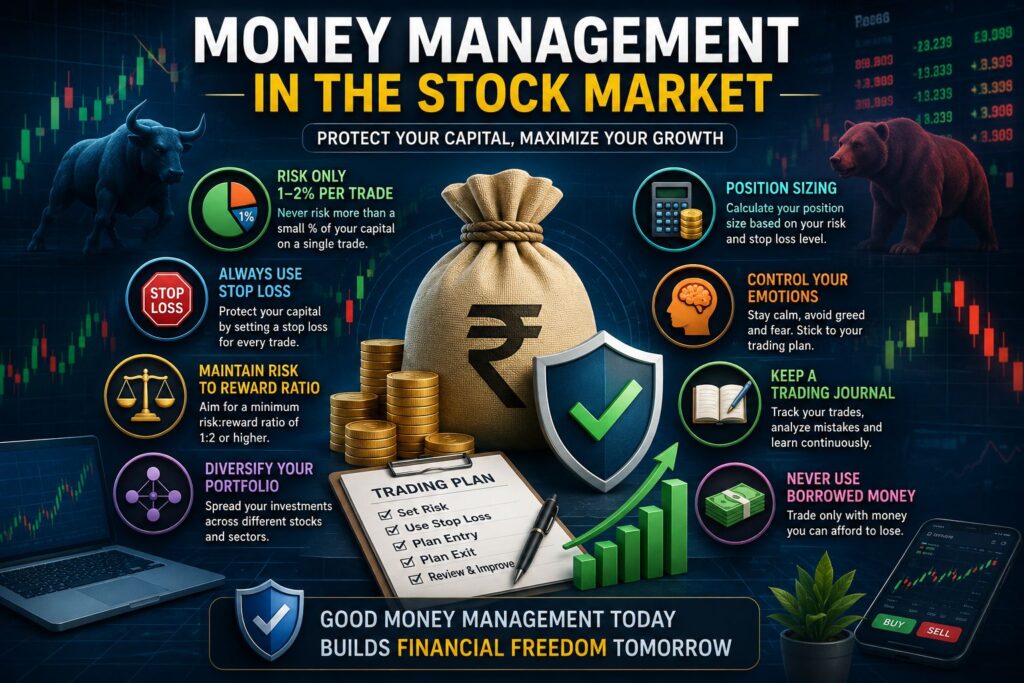
What is Money Management in the Stock Market?
Money management in the stock market means the management of your capital in an appropriate manner. This includes the determination of the amount of money that you will trade with, how much you are willing to risk from one transaction, and protecting your capital during your losses.
The main aim here is not the maximum profit from every transaction but the protection of your capital so that you will keep on trading.
The Importance of Money Management
Novices concentrate exclusively on selecting profitable stocks and timing. Without Money Management in the Stock Market, having a high winning ratio may fail to translate into profitability despite that.
Below are some of the advantages:
- It safeguards your trading capital.
- It eliminates emotions from decision-making.
- It helps you avoid making huge losses.
- It ensures you remain in the market through hard times.
Effective money management enables one to be disciplined irrespective of the market situation.
Fix Your Trading Budget
When managing money in the stock market, the first thing to do is determine how much money you are able to invest.
Never allocate money that you need for your necessities, emergency situations, or loan repayment. The stock market is risky and you must only use your disposable income. Stock market investment tips.
Another way to manage your money effectively in the stock market is by setting up a special trading account.
Always Never Invest Too Much in One Trade
One of the most common principles practised by many successful traders is the 1% or 2% risk principle.
For instance:
- Trade Capital: ₹2,00,000
- Risk per Trade: 1%
- Loss Permitted: ₹2,000
Such a strategy ensures that no single trade will harm your entire portfolio.
Adhering to such a principle is one of the most efficient ways of money management in the stock markets.
Know About Position Sizing
Position sizing is the act of determining how many stocks to purchase depending on your risk tolerance.
Rather than purchasing a fixed quantity of shares at every opportunity, compute your position taking into consideration the following factors:
- Trading capital
- Price of entry
- Distance of stop loss
- Risk per trade
With proper position sizing every trade will have an amount of risk related with it.
Always Use Stop Loss
A stop loss is one of the most powerful tools in money management in the stock market.
A stop loss automatically limits your losses if the trade moves against you. This will ensure that your small losses don’t soon become big losses.
Advantages of using the stop-loss are as follows:
- It reduces risks involved
- It eliminates any emotions from decision-making
- It helps to protect the trading account
- It brings about discipline
Never use the stop-loss after the price has moved against you. Decide on it before initiating the trade.
Keep the Balance Right for Risk-to-Reward Ratio
It’s not that successful traders always win but that they win more than they lose.
One popular risk-to-reward ratio is 1:2.
For instance,
- Risk: ₹500
- Reward: ₹1,000
Even when you win 50% of the time, the risk-to-reward ratio can keep you in the black.
It is a vital component of Money Management in the Stock Market.
Diversify Your Portfolio
Investing all your money in one stock is very risky for you.
Diversification will help you to reduce the risks among various stocks.
A diversified portfolio could contain stocks from:
- Banks
- Information Technology
- FMCG
- Pharmaceuticals
- Energy
Diversification mitigates the risks of bad performance from a single investment and improves money management in the stock market.
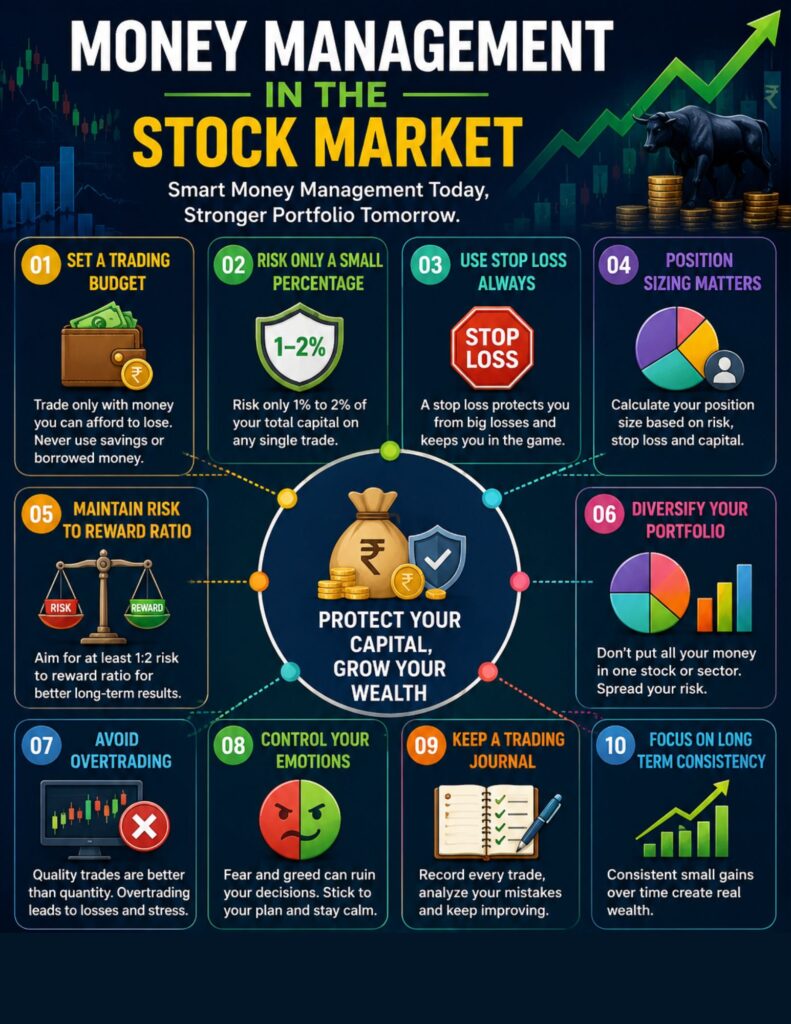
Over-Trading
There is an assumption that many traders hold, which assumes that more trades result in more gains.
However, too much trading results in:
- Increased broker fees
- Emotional decisions
- Poor trades
- Large losses
- Good trades beat fast trades any day.
Patient investors tend to do better compared to those who always want to follow every single movement in the market.
Control your Emotions
Fear and greed are the two major obstacles for any trader.
Fear makes traders exit their profitable deals too soon, while greed pushes traders to take excessive risks.
Proper management of money in the stock market minimises emotional stress since each transaction comes with limited risks.
Adhering to a written trading plan will ensure discipline during profitable as well as unprofitable trading periods.
Maintain a Trading Diary
A good trader always maintains trading records.
These records must consist of the following information:
- Entry price
- Exit price
- Stop loss
- Target
- Reason for opening trade
- Profit/loss
- Lessons learned
Examining your trading journal is an excellent way to find where you’ve gone wrong.
Common Mistakes in Money Management
There are many reasons why beginners may make losses.
These may include the following:
- Trading without using a stop loss order.
- Risky management of capital.
- Averaging down on losing positions without a strategy.
- Trading using money that has been borrowed.
- Position sizing is not considered.
- Trades are made in an attempt to recover from losses.
Not making these errors will greatly enhance your trading results.

Money Management Tips for Long-Term Success
Here are some practices you need to observe for money management in the Stock Market:
- Put a small amount of your money when trading.
- Make use of stop losses regularly.
- Always have a good risk-to-reward ratio.
- Diversification of Investments.
- Do not trade emotionally.
- Continue learning anddeveloping your skills in trading.
- Analyse your trading activities.
- Take care of your capital first before looking for profits.
Consistency comes from discipline, not from chance.
Conclusion
Trading success does not depend on the number of successful transactions you carry out, but rather on how effectively you manage your risks. That is why money management in the stock market is considered to be the most crucial skill any trader must have.
Whether you are a novice or a professional trader, using sound money management principles in the stock market will go a long way towards helping you preserve your money, avoid unnecessary risk, and instil a sense of confidence in yourself.
By making money management in the stock market one of the key components of your trading plan, you will have more capacity to cope with market unpredictability and, at the same time, increase your probability of success.