
When it comes to personal finance long-term investment in the stock market has always been one of the most efficient ways to create wealth. Although short-term trading tends to grab people’s attention due to its potential for rapid gains, long-term investment is all about the virtues of patience, discipline and the magic of compounding. Those who know the trick are likely to be financially successful.
Today, many new investors want fast results, but history shows that long-term investment in the stock market rewards those who stay invested through market cycles. This blog explains the concept in depth, clears common myths, and helps you understand why this strategy is essential for serious wealth creation.
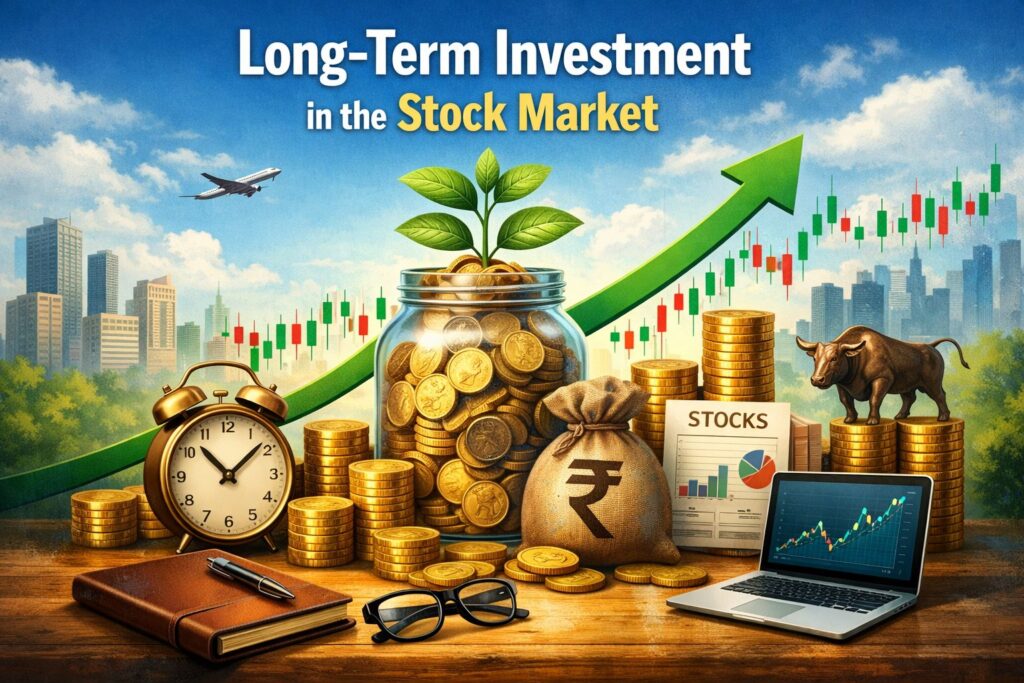
What Is Long-Term Investment in the Stock Market
Long-term investment in the stock market is the act of investing in quality stocks, mutual funds or ETFs and holding them for a period of 5, 10 or even 20 years. The primary objective of long-term investment is not to make money from market fluctuations but to make money from business growth, increased earnings, dividends, and compounding.
Unlike trading, where timing the market is of utmost importance, in long-term investment, time in the market is of prime importance. Good companies usually grow along with the economy and boost their profitability, which has a positive effect on their stock prices.
Why Long-Term Investment Works Better Than Short-Term Trading
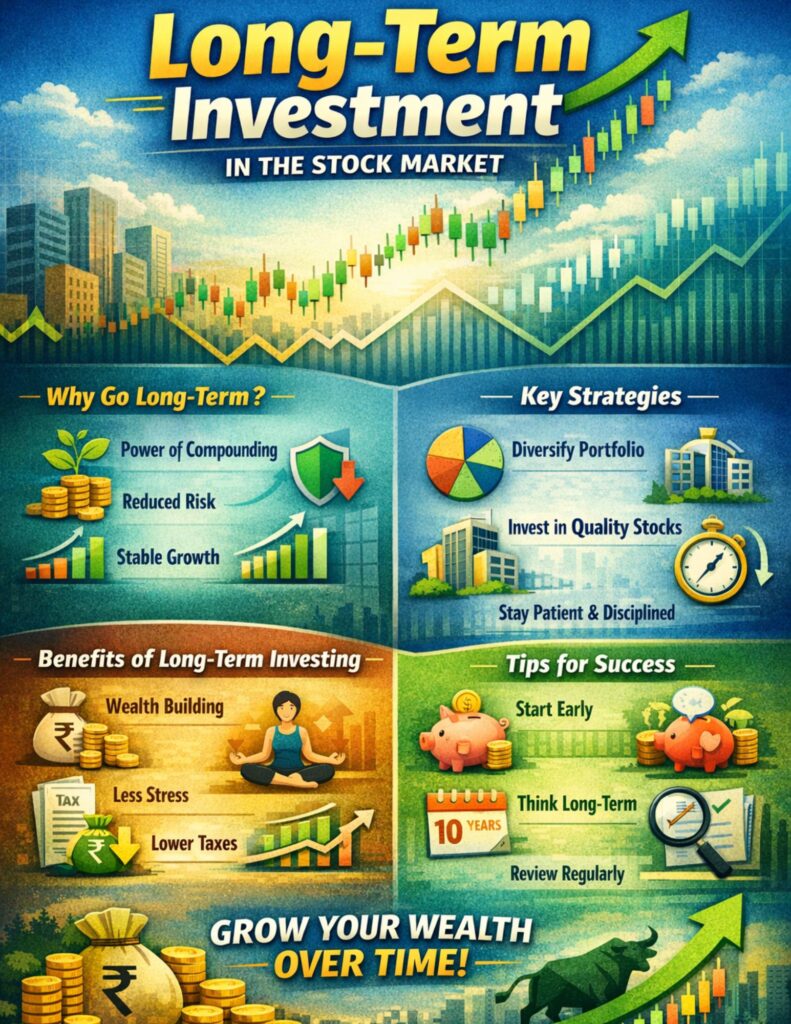
One of the biggest advantages of long-term investment in the stock market is reduced stress. Investors do not have to track price movements daily or make decisions based on emotions that arise from news and market movements. They track business fundamentals and economic growth.
Another significant advantage is that there are lower transaction costs. When individuals buy and sell stocks daily, they pay brokerage fees, taxes, and make decisions. Long-term investors make fewer trades, pay fewer taxes on gains, and let their profits compound without a break.
The Power of Compounding
Albert Einstein once said that compounding is the eighth wonder of the world, and the stock market is where the power of compounding can be best utilised. When you reinvest your dividends and let your gains make gains, the result is exponential, not linear.
If you invest ₹1,00,000 at a compound rate of 12% per annum, you will get around ₹3,10,000 in 10 years and over ₹9,60,000 in 20 years. This is not because of market timing but because of the magic of compounding.
Risk Management Through Long-Term Investing
It is a common myth that the stock market is a risky place. The fact is that long-term investing in the stock market is less risky than short-term investing. Market fluctuations are inevitable in the short term, but quality stocks always bounce back.
Diversification further reduces risk. By investing across sectors and asset classes, long-term investors protect their portfolios from sector-specific or temporary economic shocks.
Common Myths Related to Long-Term Investing in the Stock Market
The first common myth is that you require a substantial amount of money to invest in the stock market. The truth is that long-term investment in the stock market can be done with small investments made through SIPs.
The second common myth is that long-term investment in the stock market is equivalent to “buy and forget.” The truth is that while patience is required, it is also necessary to check the fundamentals of the company from time to time.
How to Create an Investment Plan for the Long Term
For a successful long-term investment in the stock market, it is essential to have financial goals like retirement planning, children’s education or creating wealth. After setting financial goals, it is necessary to choose companies with good management and growth prospects.
Asset allocation is also equally important. A balanced mix of equity, debt and other assets helps maintain stability while maximising growth over time.
The Role of Discipline and Patience
Discipline is the backbone of long-term investment in the stock market. Emotional responses to market crashes or rallies can cause people to make poor investment decisions. Smart investors know that market corrections are a normal part of the market cycle and see them as opportunities not threats.
Historically, staying in the market during a downturn has provided better returns than leaving the market due to fear and attempting to re-enter at a later date.
Long-Term Investment in the Indian Stock Market Context
In the Indian stock market context, long-term investment has created uncountable wealth over the years. The Nifty 50 and Sensex stock market indices have provided outstanding returns performance despite market volatility, economic slowdowns, and global events.
The Indian economic growth, young population and increasing participation in financial markets make long-term equity investment an attractive option for Indian investors.
Errors to Avoid in Long-Term Investment
The first mistake in long-term investment in the stock market is following trends or tips without research. Investing based on rumours often leads to disappointment.
Another mistake is a lack of diversification. Placing all funds in one stock or industry is unnecessary risk and goes against the goal of long-term stability.
How New Investors Can Start Long-Term Investing
New investors can start their long-term investment journey in the stock market with education. Learn about basic concepts such as risk, return, valuation, and market cycles can go a long way in building confidence.
Index funds, blue-chip stocks, or mutual funds can be a better starting point for newbies. Once they gain some experience, they can move on to stocks and advanced investing.
The Role of Financial Education
A successful long-term investment in the stock market is fully dependent on financial education. Those who are educated about the markets are less likely to make impulsive decisions when the markets are volatile.
A well-designed learning process, practical market experience, and mentorship can significantly lower the learning curve and enhance the quality of decision-making.
Long-Term Investing vs Other Investment Options
When compared to fixed deposits, gold, or real estate, long-term investment in the stock market provides better returns even after adjusting for inflation over a long period of time. Although other investments provide stability or diversification benefits, equities remain the key drivers of wealth creation.
A investment portfolio includes a combination of different investments, but equities form the key driving force.

Final Thoughts: Is Long-Term Investing Worth It?
long-term investment in the stock market does not mean making money quickly, but a means of achieving financial freedom. It is a process that require patience, discipline and knowledge. It reduces emotional and financial stress.
If you are serious about building you financial future, then long-term investment in the stock market is one of the best financial decisions you can make.